 Formsy
Sole Proprietorship Registration Online in India
Starting a sole proprietorship is one of the easiest and most cost-effective ways to launch your business in India. Launch your business the smart way—fast, affordable, and backed by expert support every step of the journey.
- GST and PAN Registration Support for Tax Compliance
- Streamlined Process with Minimal Paperwork
- Ideal for Both Local and Online Businesses
- Post-Registration Compliance and Advisory Services
Enter your details to receive a full quote and consultation

What is Sole Proprietorship Registration?
According to the Ministry of Corporate Affairs, over 60% of registered businesses in India operate as sole proprietorships, making it the most widely chosen business structure among entrepreneurs. This popularity highlights the simplicity and accessibility of sole proprietorships, especially for startups and small-scale enterprises.
Sole proprietorship registration in India is the process of formally establishing a business owned and managed by a single individual under Indian law. This business structure offers the simplest and most flexible form of business organization, granting the owner complete control over all operations and decisions.
The registration process typically includes obtaining essential licenses and registrations such as GST registration, Shop and Establishment License, and other industry-specific permits required to legally operate the business. This ensures compliance with regulatory norms and establishes a foundation for smooth business functioning.
Key Objectives of Sole Proprietorship Registration
The primary objective of sole proprietorship registration is to establish a legally compliant business structure that enables individual entrepreneurs to operate their ventures with proper documentation and regulatory compliance.
- Legal Business Identity: To establish a formal business identity separate from personal identity for professional dealings.
- Regulatory Compliance: Ensure compliance with applicable laws, regulations, and licensing requirements for business operations.
- Banking Relationships: Enable the opening of business bank accounts and establish proper financial infrastructure for business transactions.
- Tax Compliance: Facilitate proper tax registration, filing, and compliance with income tax and GST regulations.
- Business Credibility: Enhance professional credibility and trustworthiness in dealings with customers, suppliers, and stakeholders.
- License Eligibility: Create eligibility for obtaining various business licenses, permits, and government registrations required for operations.
- Financial Access: Establish qualification for business loans, credit facilities, and other financial services from banks and institutions.
- Contractual Capacity: Enable entering into legal contracts, agreements, and business arrangements with proper documentation.
Laws and Legal Acts Governing Sole Proprietorship Registration
Sole proprietorship firm registration in India is governed by various laws and regulations that establish the framework for individual business operations and compliance requirements.
- Income Tax Act, 1961: Income tax obligations in India govern the taxation of business profits and the filing of Income Tax Returns (ITR). proprietors must obtain PAN registration and comply with tax laws, ensuring timely ITR filing under the applicable income tax slabs. This process simplifies tax compliance for sole proprietors while maintaining adherence to government regulations.
- Goods and Services Tax (GST) Act, 2017: Mandates GST compliance for businesses exceeding specified turnover thresholds. GST registration is mandatory for turnover above ₹20 lakhs (₹10 lakhs for special category states). Requires monthly and annual returns, along with timely tax payments.
- Shop and Establishment Acts (State-wise): Regulates the operation of commercial establishments. Registration is needed for business premises under state laws. Regulates aspects like working hours, employee rights, and operational guidelines for the business premises.
- Labor and Employment Laws: Applies when a business employs staff or workers. Includes ESI, EPF, and the Payment of Wages Act. Ensures employee welfare and statutory benefits.
- Professional Tax Laws (State-wise): State-specific tax applicable to professionals and trades. Sole proprietors may be liable for professional tax. Rates and exemptions vary across states.
- FSSAI Registration (for Food Businesses): Mandatory for all food-related business operations. Ensures food safety and hygiene compliance. Applies to manufacturers, traders, and food outlets.
- Environmental Clearances: Required for businesses with environmental impact. Necessary for manufacturing or polluting activities. Involves pollution board approvals and assessments.
- Industry-Specific Regulations: Applies based on the nature of the business. Covers sectors like pharmaceuticals, textiles, and chemicals. May include licenses, safety norms, and quality standards.
Types of Sole Proprietorship Registration in India
Sole proprietorships in India can encompass various business activities, often categorized by their nature and regulatory needs:
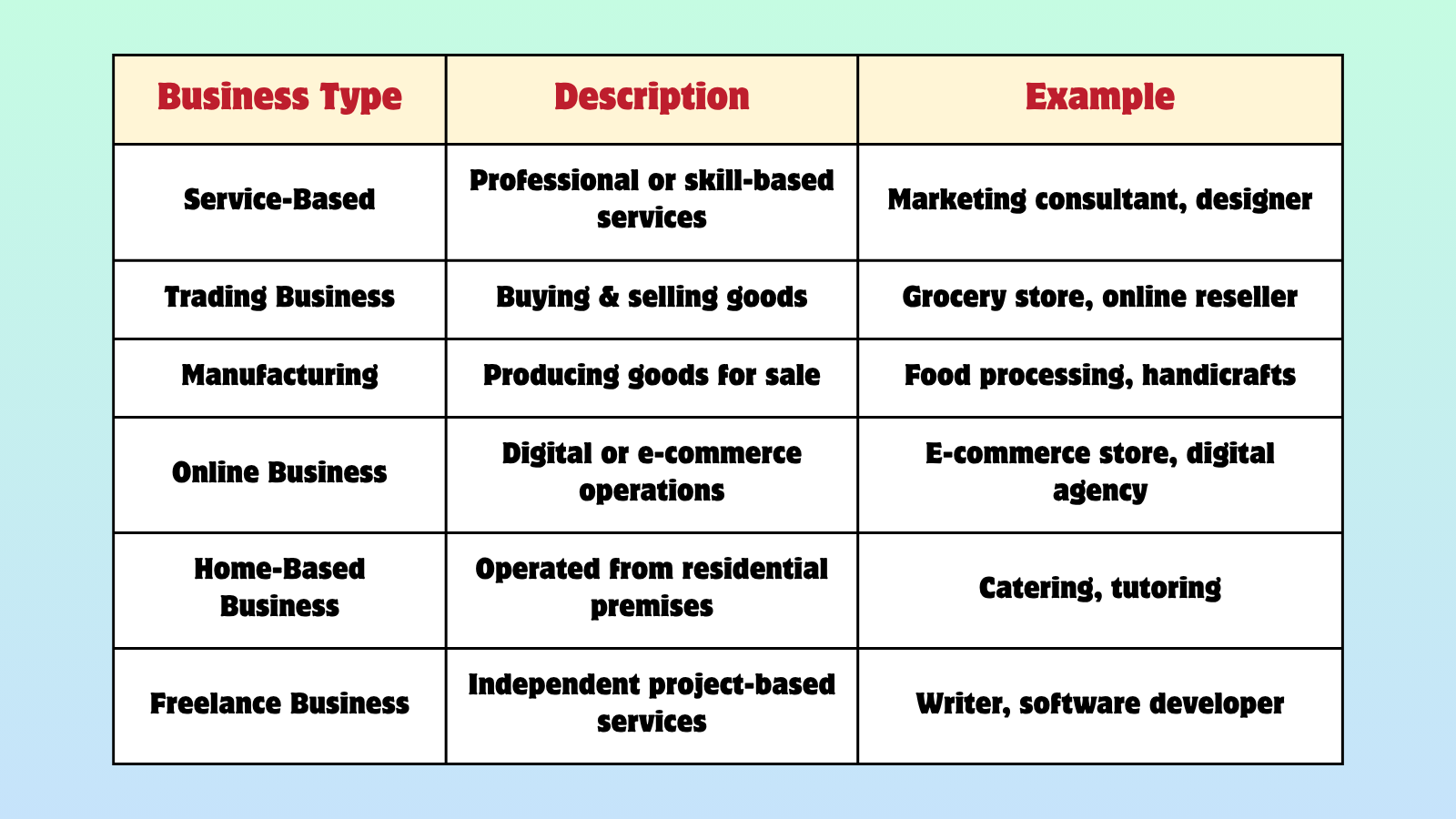
1. Service-Based Sole Proprietorship
This covers businesses providing professional services, consultancy, or skill-based offerings to clients.
Example: A freelance marketing expert registers his/her sole proprietorship to offer design services to corporate clients and maintain proper business records.
2. Trading Business Sole Proprietorship
For businesses involved in buying and selling goods, whether retail or wholesale trading operations.
Example: An individual registers a sole proprietorship to operate a retail grocery store or an online marketplace business (which may require GST registration).
3. Manufacturing Sole Proprietorship
Covers small-scale manufacturing operations where an individual produces goods for sale in the market.
Example: A person starts a small food processing unit or handicraft manufacturing business under a sole proprietorship structure and may also benefit from MSME registration.
4. Online Business Sole Proprietorship
For digital businesses, e-commerce operations, or online service providers operating through digital platforms.
Example: An entrepreneur registers their sole proprietorship to operate an e-commerce website or provide digital marketing services online especially for global selling through import export code registration.
5. Home-Based Business Sole Proprietorship
For businesses operated from residential premises, including small-scale operations and service providers.
Example: A person running a home-based catering service or tutoring center registers as a sole proprietorship for legal compliance.
6. Freelance Business Sole Proprietorship
For independent contractors and freelancers providing specialized services to multiple clients on a project basis.
Example: A content writer or software developer registers their freelance business as a sole proprietorship for professional credibility.
Eligibility Criteria for Sole Proprietorship Registration
A checklist before registering a sole proprietorship includes meeting basic legal criteria under Indian laws and regulations.
- Individual Ownership Requirement: Only a person can establish and operate a sole proprietorship; corporate entities or groups cannot form this business structure.
- Age and Legal Capacity: The proprietor must be a major (18 years or above) with legal capacity to enter into contracts and conduct business.
- Indian Residency Status: While Indian citizenship is not mandatory, the proprietor should have legal residency status and necessary permissions to conduct business in India.
- PAN Card Requirement: A valid Permanent Account Number (PAN) is mandatory for tax compliance and business registration purposes.
- Aadhaar Card Documentation: Aadhaar card or equivalent identity proof is required for various registrations and compliance procedures.
- Business Address Proof: Valid address proof for the business location, whether owned, rented, or operated from residential premises.
- No Disqualification Status: The individual should not be disqualified under any law from conducting business or have been declared insolvent.
- Compliance Capability: Ability to understand and comply with applicable business laws, tax obligations, and regulatory requirements for the chosen business activity.
Documents Required for Sole Proprietorship Registration
Proper documentation is essential for successful sole proprietorship registration, with specific documents required for various aspects of business establishment:
Identity and Address Documents
- PAN Card: Original and photocopy of the proprietor's Permanent Account Number.
- Aadhaar Card: Identity and address proof with current details. Bank statement can act as the address proof.
- Passport: For identity verification and address proof (if applicable).
- Voter ID Card: Alternative identity proof acceptable for registration purposes.
Business Address Proof
- For owned premises: Property deed, tax receipts, or utility bills in the proprietor's name.
- For rented premises: Rent agreement along with the owner's NOC and property documents.
- For residential premises: Utility bills and residential address proof documents.
- Municipal permissions: Any required permissions for operating a business from the chosen location.
Business-Specific Registrations
- Shop and Establishment Certificate: Required for most business operations.
- GST Registration Certificate: Mandatory if turnover exceeds threshold limits.
- Trade License: From local municipal authorities for commercial operations.
- Professional Tax Certificate: State-specific registration for professional activities, mandatory in Maharashtra.
Bank Account Documentation
- Current Account Opening Forms: As required by the chosen bank.
- Initial Deposit: Minimum amount as specified by the bank's current account requirements.
- Business Registration Proofs: All obtained registrations and licenses for account opening.
- Passport-size Photographs: Recent photographs of the proprietor for bank records.
How to Register a Sole Proprietorship in India?
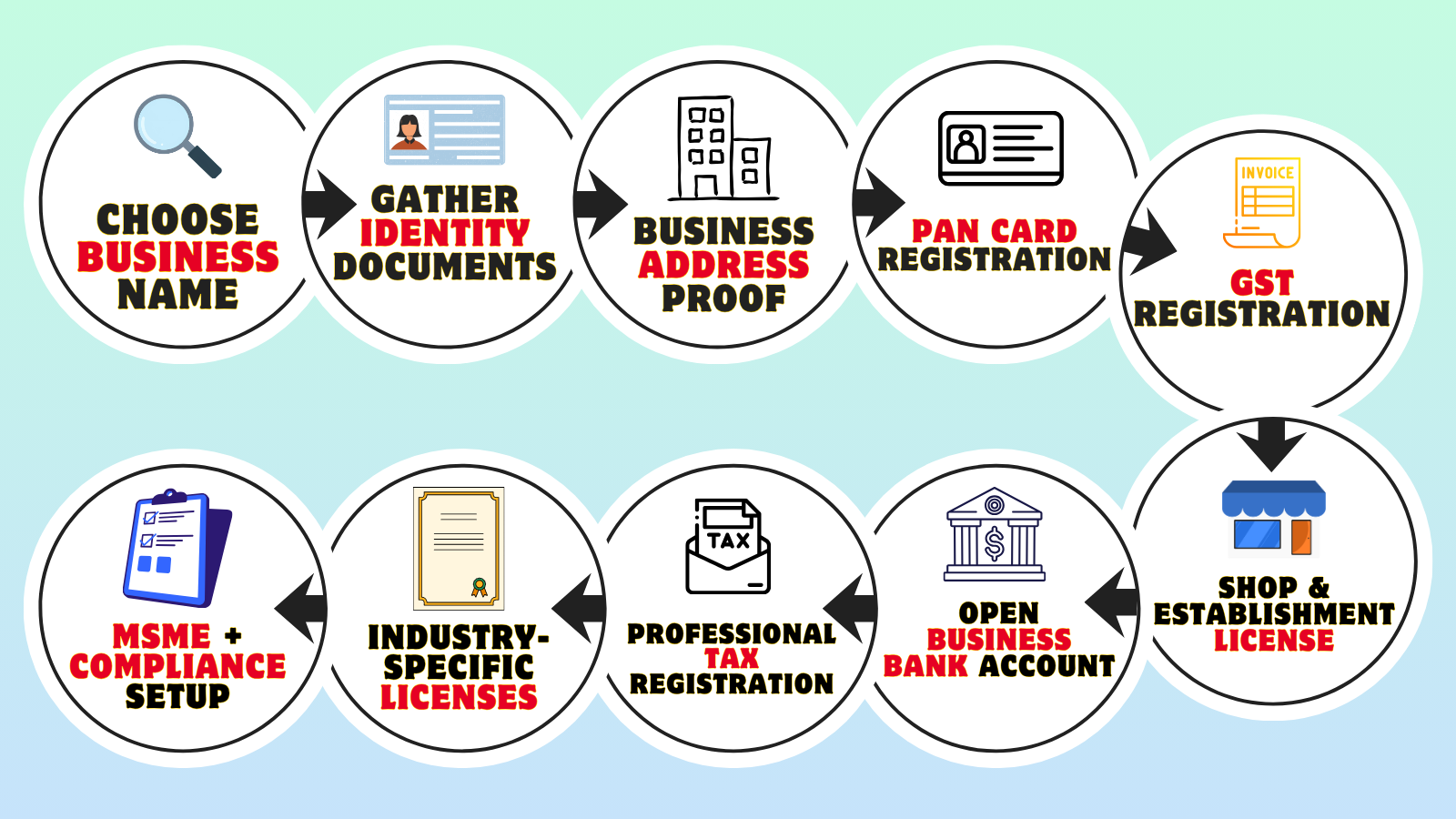
Registering a sole proprietorship in India involves a systematic process that establishes your business with proper legal compliance and documentation:
- Choose Business Name and Activity: Select a unique and appropriate name for your business. Clearly outline the nature of your business activities. Ensure the name is not already in use by checking local business listings or trademark databases.
- Obtain Required Identity Documents: Gather essential documents, including PAN Card, Aadhaar Card, Address proof (e.g., utility bill, bank statement), and Passport-size photographs.
- Secure Business Address Documentation: Secure documents for your business location, such as a Rent agreement (if rented), Property ownership documents (if owned), or a Utility bill (electricity, water, etc.) as supporting proof.
- Apply for PAN Card (if not available): Obtain a PAN card in your name, which will serve as the business PAN for tax compliance and other registrations.
- Register for GST (if applicable): GST registration is mandatory if your turnover exceeds ₹20 lakhs (₹10 lakhs in special category states), or you’re involved in interstate supply or e-commerce. Apply via the GST portal.
- Obtain Shop and Establishment License: Apply for shop and establishment registration with local municipal authorities or the state labor department as required, if necessary.
- Open a Business Bank Account: Open a current account in your business name. Banks typically require proof of business identity (GST, Shop Act, etc.), PAN and Aadhaar, Address proof, and Business registration certificates.
- Apply for Professional Tax Registration: Register for professional tax with state authorities if applicable, based on your state's professional tax laws and business nature.
- Obtain Industry-Specific Licenses: Apply for additional licenses like FSSAI for food business, trade license from local authorities, or other sector-specific permits.
- Complete MSME Registration (optional): Consider registering under MSME (Udyam Registration) for benefits like easier loan access and government scheme eligibility.
- Set up Accounting and Compliance System: Establish proper books of accounts and a compliance management system for tax filings and regulatory requirements.
Still confused on how to register a sole proprietorship with ease? Our expert team is here to guide you with the process.
Launch Your Business with Formsy!
Get your Sole Proprietorship registered hassle-free. Our experts ensure a smooth and compliant process from start to finish.
Fees for Sole Proprietorship Registration
Costs for registering a sole proprietorship help entrepreneurs budget better when starting their business.
1. Registration Charges
In India, registering a sole proprietorship includes paying various government fees for professional services related to different types of registrations.
- GST Registration: Free of cost for online applications.
- Shop and Establishment License: Rs. 1,000 - Rs. 5,000 depending on the state and business nature.
- Professional Tax Registration: Rs. 1,000 - Rs. 2,000 based on state regulations.
- Bank Account Opening: Rs. 3,000 - Rs. 5,000 as account opening charges and minimum balance.
- Professional Service Fees: Rs. 7,000 - Rs. 15,000 for complete registration assistance from consultants.
2. Additional Compliance Costs
Ongoing operational costs and compliance expenses for maintaining a sole proprietorship business.
- GST Filing Charges: Rs. 4,000 - Rs. 7,000 per quarter for professional GST return filing (covering all returns filed within that quarter).
- Income Tax Return Filing: Rs. 3,500 - Rs. 5,000 annually for ITR preparation and filing.
- Accounting and Bookkeeping: Rs. 4,000 - Rs. 10,000 per month for professional accounting services.
- Audit Fees: Rs. 15,000 - Rs. 25,000 if turnover exceeds Rs. 1 crore (tax audit requirement, thresholds may vary based on specific conditions under the Income Tax Act).
- Legal Compliance: Rs. 10,000 - Rs. 15,000 annually for ongoing legal compliance and documentation.
Benefits of registering a Sole Proprietorship
- Less Compliance and Low Cost: Starting a sole proprietorship in India is straightforward with minimal regulatory compliance and lower setup costs compared to companies or LLPs. This makes it an economical choice for small businesses and startups seeking quick incorporation and easy operations.
- Complete Control and Privacy: The sole proprietor has full control over business decisions, allowing for flexible and confidential management. Since the business is owned by one person, there is no need to disclose accounts or business information publicly, ensuring business confidentiality.
- Quick Decision Making: With no need for consultations or approvals from partners or boards, the sole proprietor can make fast, independent decisions, which is beneficial in dynamic and competitive markets.
Compliances Required After Registration
Once your sole proprietorship is registered, you must follow certain ongoing compliances to keep your business legally valid and operational:
- GST Return Filing: If registered under GST, monthly or quarterly returns must be filed through the GST portal.
- Income Tax Filing: File annual income tax returns under the individual's PAN, reporting all business income.
- TDS (Tax Deducted at Source) Compliance: If liable to deduct TDS, deposit it monthly and file quarterly TDS returns.
- Professional Tax Payment: If applicable in your state, pay professional tax monthly or annually based on local laws.
- Shop & Establishment Renewal: Renew the license as per the validity period specified by your local authority.
- Maintaining Books of Accounts: Maintain detailed records of income, expenses, purchases, sales, and bank transactions.
- Audit Requirements: If your turnover exceeds the prescribed limit (Rs. 1 crore or Rs. 50 lakh for professionals), a tax audit under Section 44AB of the Income Tax Act is mandatory.
- Advance Tax Payments: If your tax liability exceeds Rs. 10,000 annually, pay advance tax in quarterly installments.
- MSME/Udyam Update (if registered): Update any business changes (address, turnover, employee count) on the Udyam portal.
- Renewal of Sectoral Licenses: Timely renewal of FSSAI, trade, or any other industry-specific licenses to avoid penalties.
Sole Proprietorship Registration Certificate
A Sole Proprietorship Registration Certificate is an official document that validates the existence of a business operated by a single individual. Unlike other business structures, a sole proprietorship is not a separate legal entity. However, registering your business provides legitimacy, helps in opening a current bank account, applying for GST, or availing government schemes. Since there is no centralized registration process for sole proprietorships in India, the registration is often validated through other documents, such as:
How to Download Your Sole Proprietorship Registration Certificate Online?
The process to download your registration certificate depends on the type of registration you opted for. Here's how you can download the most common ones:
GST Registration Certificate
- Visit the GST Portal
- Log in using your credentials (GSTIN, username, and password)
- Go to Services > User Services > View/Download Certificates
- Click on the download icon next to your registration certificate.
Udyam (MSME) Registration Certificate
- Visit the Udyam Portal
- Click on Print/Verify
- Enter your Udyam Registration Number and mobile number linked to Aadhaar
- Download the certificate in PDF format.
How to Check the Status of Sole Proprietorship Registration Online?
To track the progress of your sole proprietorship registration, you can check the status via the relevant government portal based on the type of registration:
1. GST Application Status
- Go to the GST Portal
- Click on Track Application Status
- Enter the ARN (Application Reference Number) to view the current status
2. Udyam Registration Status
- Visit Udyam Portal
- Go to Verify Udyam Registration Number
- Enter your registration number to check its validity and status
Frequently Asked Questions (FAQs)
What is the main disadvantage of a sole proprietorship?
The biggest disadvantage is unlimited liability. Since the business is not a separate legal entity, the owner is personally responsible for all business debts and liabilities. This means personal assets like a car or house could be at risk if the business fails.
Can a sole proprietorship be converted to a private limited company later?
Yes, a sole proprietorship can be converted into a Private Limited Company or a One Person Company (OPC). This is a common step for growing businesses that want to raise funds, limit liability, or bring in partners.
Is there a separate PAN card for a sole proprietorship?
No, a sole proprietorship does not get a separate PAN card. The owner's individual PAN is used for all business and tax-related purposes.
How many people can own a sole proprietorship?
As the name suggests, a sole proprietorship can only be owned by one single individual. If you want to start a business with a partner, you would need to register as a partnership Firm or a Limited Liability Partnership (LLP).
Who can start a sole proprietorship in India?
Any Indian citizen above 18 years of age can start a sole proprietorship business with the required registrations and licenses.
Is GST registration mandatory for a sole proprietorship?
GST registration is mandatory only if the business turnover exceeds the prescribed limit or falls under mandatory GST registration criteria.
What documents are required for sole proprietorship registration?
Basic documents include PAN Card, Aadhaar Card, address proof, bank account details, and business address proof.
Can a sole proprietorship hire employees?
Yes, a sole proprietorship can hire employees as per business requirements and applicable labor laws.
Is there any minimum capital required to start a sole proprietorship?
No, there is no minimum capital requirement to start a sole proprietorship in India.