 Formsy
Private Limited Company Registration Online in India
Looking to register a Private Limited Company (Pvt Ltd Company) in India? Launch now in India the Right Way—100% Online, Fast, and Professionally Assisted.
- Quick online process—get registered in 8–10 business days
- Legal recognition by the MCA
- Boost credibility and fundraising opportunities
- Seamless registration support at affordable pricing
- COI, MOA, AOA, DIN, PAN TAN, DSC
- Most trusted choice for startups and SMEs
Enter your details to receive a full quote and consultation

What is a Private Limited Company?
A Private Limited Company (Pvt. Ltd. Company) is a separate legal entity, privately owned by a minimum of two and a maximum of 200 shareholders. It's the go-to business structure in India, especially for startups and growing enterprises seeking robust legal protection and credibility.
Key Advantage: Unlike OPC, sole proprietorships, or partnerships, a Pvt. Ltd. company offers limited liability, meaning shareholders' personal assets are safeguarded from business debts and losses. Your financial risk is limited strictly to the value of your shares, providing peace of mind as you build your venture.
Key Features of a Private Limited Company
This versatile structure offers entrepreneurs a blend of professional credibility and operational flexibility. Here’s why it’s a preferred choice:
- Flexible Ownership: Requires a minimum of 2 and a maximum of 200 members (shareholders), offering scalability.
- Distinct Legal Identity: Operates as a separate legal entity under the Companies Act, 2013, capable of owning assets, entering into contracts, and engaging in legal actions independently.
- Unparalleled Limited Liability: Protects shareholders' personal assets; their financial risk is strictly limited to their shareholding value.
- Perpetual Succession: Ensures the business continues uninterrupted, regardless of changes in shareholders or directors, fostering long-term stability.
- Enhanced Credibility: Highly favored by investors, banks, and venture capitalists, making it easier to secure funding and build market trust.
- Professional Structure: Provides the framework for robust governance and professionalism, ideal for ambitious growth.
Understanding Private Limited Company Registration
Private Limited Company Registration is the formal process of legally establishing your business under the Companies Act, 2013. This crucial step not only grants your enterprise a recognized corporate identity but also:
- Separates Personal & Business Assets: Providing a vital shield against business liabilities.
- Boosts Investor Appeal: Position your company for easier access to funding and capital.
It's the ideal business structure for startups, rapidly growing businesses, and for any entrepreneur with aspirations to raise capital or scale operations, especially after setting up supporting registrations such as Startup India registration and MSME. To initiate the process, a Private Limited Company must have a minimum of two directors and two shareholders.
Key Objectives of Registering a Private Limited Company
Beyond mere compliance, registering your Private Limited Company unlocks strategic advantages vital for long-term success:
- Establish Legal Personality: Secure a recognized business identity to build credibility with clients and lenders.
- Protect Personal Assets: Shield founders’ wealth from company debts and liabilities.
- Access Funding: Facilitate investment by issuing equity shares to angel investors, VCs, or strategic partners.
- Ensure Continuity: Maintain uninterrupted operations, even if shareholders or directors change.
- Qualify for Government Benefits: Get tax incentives, grants, and schemes available to registered companies through initiatives such as Startup India registration and MSME.
Types of Private Limited Companies
While the primary focus for most entrepreneurs is a Company Limited by Shares, it's important to understand the broader categories. The key difference among these types lies in the extent of members' liability in case of company losses or dissolution:
1. Company Limited by Shares:
In this widely adopted structure and the one accepted by the Ministry of Corporate Affairs (MCA), the liability of each shareholder is strictly limited to the unpaid amount on their shares. Once shares are fully paid, there is no further personal liability.
2. Company Limited by Guarantee:
Members agree to pay a predetermined amount only if the company is wound up. This guarantee sum is explicitly stated in the Memorandum of Association (MOA) and is typically favored by non-profit organizations or professional associations.
3. Unlimited Company:
Members have no limit on their liability. If the company cannot pay its debts, members may have to use their funds. Still, the company has its own legal identity, so members are not sued directly.
Example: Some family-owned businesses choose this structure for more control and privacy.
Eligibility Criteria for Private Limited Company Registration
To successfully register a Private Limited Company in India, specific statutory requirements must be fulfilled. Here’s a breakdown of the key eligibility criteria:
- Minimum Directors: A minimum of two directors is mandatory for company registration.
- Resident Director Requirement: At least one director must be an Indian Resident and a citizen, having stayed in India for a minimum of 182 days in the preceding financial year.
- Maximum Directors: A Private Limited Company can appoint up to 15 directors by default. However, this number can be increased beyond 15 by passing a special resolution with shareholder approval.
- Shareholders: A minimum of two shareholders are required for incorporation. Importantly, the same individuals can hold both director and shareholder positions.
- Shareholder Limit: The total number of shareholders is limited to 200, excluding current and former employee-shareholders under ESOPs or similar plans.
- Registered Office: The company must have a registered office in India. This address will be used for all official government communications and requires valid address proof, along with a No Objection Certificate (NOC) from the property owner irrespective of the premises being rented/leased/owned.
- No Minimum Paid-up Capital: There is no mandatory minimum paid-up capital required, yet it has to be kept based on the number of shareholders. However, the company must declare its authorized share capital, for which a government fee is applicable during registration.
- Director Identification Number (DIN): Every director must obtain a unique Director Identification Number (DIN), issued by the Ministry of Corporate Affairs (MCA).
- Digital Signature Certificate (DSC): All proposed directors are required to obtain a Class 3 Digital Signature Certificate (DSC). It is used for digitally signing the incorporation documents during the registration process.
Documents Required for Private Limited Company Registration
Gathering the correct documentation is a critical step. Formsy simplifies this process, but here's a detailed checklist of what you'll need:
For Directors and Shareholders (Indian Nationals)
- PAN Card (Mandatory)
- Aadhar Card/Driving License/Ration Card/Passport
- Recent passport-sized photograph
- Address Proof (any one): Latest Residential Utility bill (electricity, gas, telecom; not older than 2 months), or Bank statement (not older than 2 months).
- Email ID & Mobile Number (linked with Aadhar preferred)
- Specimen signature
For Foreign Directors/Shareholders (Additional Documents)
- Passport; mandatory (with visa details, if applicable)
- Address Proof from Home Country (e.g., utility bill, bank statement; not older than 2 months)
- All foreign documents must be Notarized and Apostilled/Consularized as per international legal requirements.
For the Registered Office Address
- Proof of Address: Latest Utility Bill (electricity, gas, telecom, not older than 2 months) or Property Tax Receipt.
- No Objection Certificate (NOC): From the property owner whose name is mentioned on the document. Businesses that do not have a commercial premises yet may also consider using a virtual office address where suitable.
- Rent/Lease Agreement Copy: (if applicable)
Company-Related Documents & Information
- Proposed Company Name Options
- Detailed Description of Business Activities and Objectives
- Details of Authorized and Paid-up Capital
- Shareholding Pattern (who holds how many shares)
- Draft of Memorandum of Association (MOA)
- Draft of Articles of Association (AOA)
- Resolution Appointing First Directors
How to Register a Private Limited Company in India?
To register a Private Limited Company in India, you need to follow a structured legal procedure outlined in these steps:
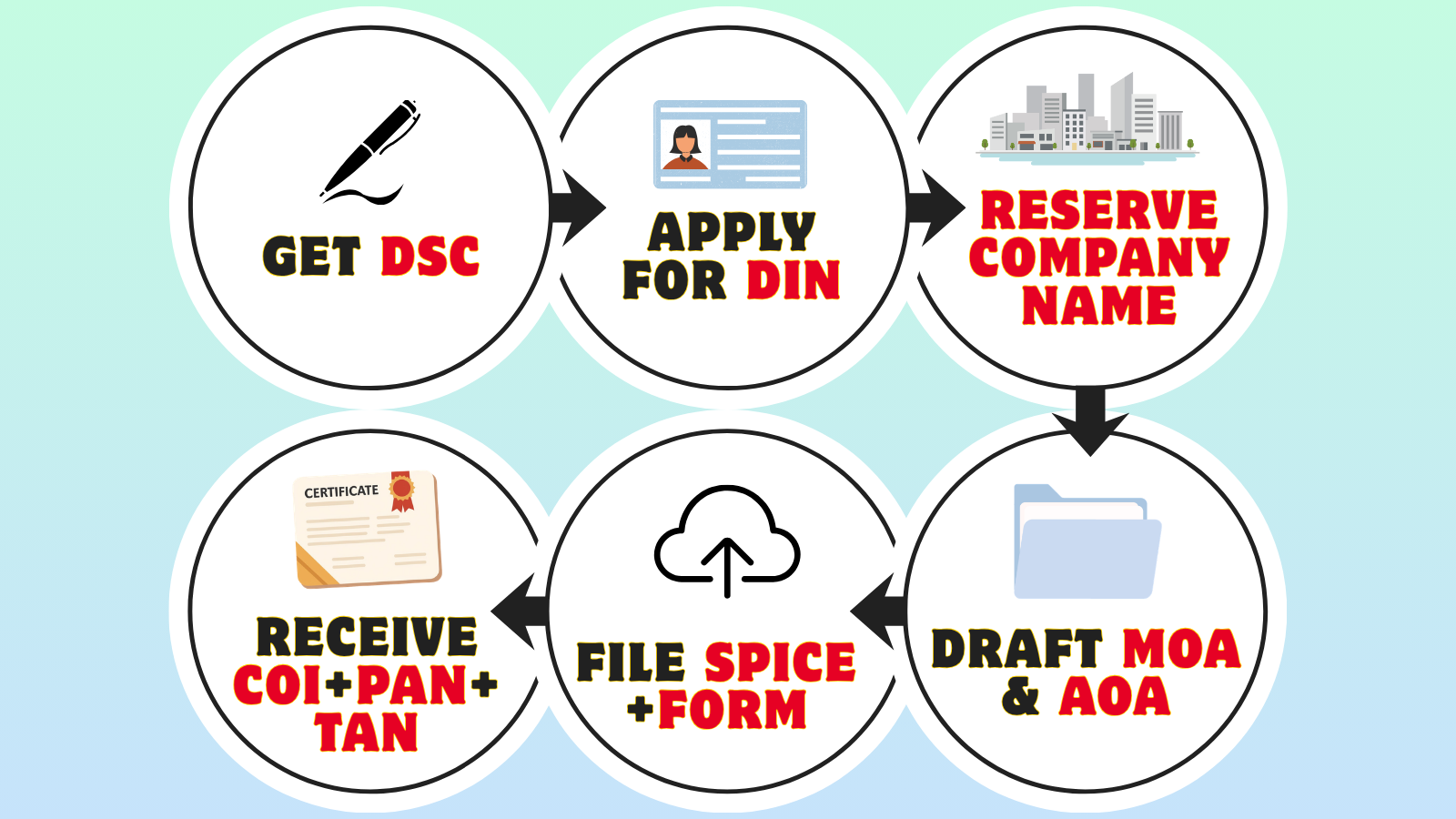
- Get Digital Signature Certificates (DSC): Each proposed director and subscriber to the Memorandum of Association (MOA) must obtain a Class 3 DSC. This is used to sign documents for a paperless registration process digitally. Validity: 2 years. Cost: Rs. 1,500 – Rs. 2,500 (varies by certifying authority). Recommended Providers: eMudhra, NIC, or other recognized agencies.
- Apply for Director Identification Number (DIN): Every director must have a unique DIN (this does not imply that a person will have multiple DIN if he is a director in multiple companies). For new companies, DINs are issued as part of the SPICe+ incorporation form, so a separate application is not needed. DIN is valid for life and remains the same even if the director changes companies. A KYC has to be done every financial year to keep the DIN active. Foreign nationals can also apply using a passport and proof of overseas address.
- Reserve Your Unique Company Name: Use the RUN (Reserve Unique Name) service on the MCA portal to request your preferred company name. You can submit up to 2 name options in an application that costs Rs. 1,000. Naming Guidelines: The name must be unique and not identical to existing companies. Should follow MCA naming rules and not include restricted words. Approval Time is usually 3–4 working days. Approved names are reserved for 20 days. If rejected, you can reapply immediately with alternate name options. Our Advantage: We conduct a thorough company name availability search to maximize your approval chances and suggest robust alternatives if needed. To protect the approved brand name after incorporation, many businesses also apply for trademark registration.
- Prepare & Draft Essential Documents: This crucial step involves drafting and finalizing key legal documents. Our team of CAs. CSs & Lawyers ensures accurate legal drafting of: Memorandum of Association (MOA) defining the company's main objectives. Articles of Association (AOA) setting rules for internal management. Director Declaration of Consent. Registered Office Proofs: Rent agreement, utility bill, and NOC from the property owner. All documents must be formatted as per MCA rules and digitally signed by the concerned parties.
- File the Incorporation Form (SPICe+): We prepare and submit the comprehensive SPICe+ form online on your behalf, along with all required documents. Pay the applicable government fees, based on your company's authorized capital. This single form covers: Company registration, MOA & AOA, PAN & TAN allotment, EPFO & ESIC registration. Ensure all files are in PDF format, and cross-check director details to avoid rejection. Depending on turnover and business activity, the next step may also include GST registration.
- Receive Your Official Certificate of Incorporation (COI): Upon successful verification by the Registrar of Companies (ROC), you will be issued the Certificate of Incorporation (COI). This pivotal document legally confirms your company's formation and includes: Your unique Corporate Identity Number (CIN), Your company’s PAN (Permanent Account Number), Your company's TAN (Tax Deduction and Collection Account Number). At Formsy, we aim to complete the process within 8–10 working days for standard applications, provided all documents are accurate and government authorities respond promptly. Once your COI is received, your business is legally ready to commence operations and open its corporate bank account, apply for GST registration, and begin formal tax compliance.
Fees and Penalties of Private Limited Company Registration
Understanding the costs involved and the repercussions of non-compliance is essential for every entrepreneur. Formsy believes in complete transparency regarding all fees and potential penalties.
Registration Costs
The overall cost for Private Limited Company registration comprises government fees, professional service charges, and some minor post-registration expenses. We provide a clear estimate upfront. Registration costs for PVTs vary based on the authorized capital & the state and professional services required for accurate submission.
- Name Reservation Fee: Rs. 1,000 for filing the name reservation form.
- Digital Signature Certificate: Rs. 2,000 - Rs. 3,000 per director, depending on validation level and provider.
- DIN/DPIN Application: Rs. 500 per director.
- Stamp Duty for OPC Registration: Varies by state and the authorized capital during the registration, typically ranging from 0.1% to 1% of the capital contribution.
Note: The fees mentioned above don’t cover the charges an PVT registration consultant might take for their services.
Penalties for Non-Compliance
Failing to adhere to the statutory requirements of the Companies Act, 2013, can lead to substantial financial penalties and legal repercussions. Proactive compliance is key to avoiding these.
| Non-Compliance / Default | Form (if applicable) | Penalty Details |
|---|---|---|
| Delay in Annual Return | Form MGT-7 | Rs. 100 per day of delay. The maximum penalty can extend to Rs. 5 lakh for serious cases. |
| Delay in Financial Statements | Form AOC-4 | Rs. 100 per day of delay. The maximum penalty can extend to Rs. 5 lakh for serious cases. |
| Failure to hold a minimum of four board meetings | N/A | Rs. 25,000 for the company and Rs. 5,000 for every officer in default. |
| Non-maintenance of Statutory Registers | N/A | Penalty up to Rs. 10,000 and an additional Rs. 1,000 per day for continuing offense. |
| Failure to Update Company Changes | N/A | Rs. 500 to Rs. 5,000 per day of continuing default. |
| Non-Disclosure of Interest by Directors | N/A | Penalty up to Rs. 1 lakh with potential disqualification. |
| Non-Compliance with CSR Requirements | N/A | Company fined up to Rs. 50,000; officers fined Rs. 1,00,000 plus Rs. 5,000/day. |
Comprehensive Benefits of Private Limited Company Registration
Choosing a Private Limited Company structure provides a robust foundation for growth, significantly boosting your business's credibility, legal protection, and access to capital. Here’s a detailed look at the advantages:
1. Robust Legal Recognition & Protection
- Separate Legal Identity: The company is recognized as a separate legal entity. It can own property, enter into contracts, and initiate or face legal action in its name.
- Limited Liability: Shareholders are protected from personal liability. Their risk is limited to the amount invested in shares.
2. Enhanced Transparency & Credibility
- Builds Trust: Being a registered company improves your credibility with clients, suppliers, and financial institutions.
- Investor Confidence: Proper compliance and structured governance help attract serious investors.
3. Financial Advantages
- Easier Access to Loans: Banks and NBFCs prefer to offer loans to registered companies over unregistered entities.
- Equity Investment Ready: You can raise funds by offering shares to angel investors, venture capital firms, or strategic partners.
4. Operational Advantages
- Easy Transfer of Ownership: Shares can be transferred smoothly, making changes in ownership or investment simple under company law.
- Asset Transactions in Company Name: The company can own, buy, or sell assets directly. Transactions are backed by board resolutions, simplifying operations compared to sole ownership.
5. Growth Opportunities
- Eligible for Government Schemes: Registered companies can benefit from schemes under Startup India registration, MSME incentives, and various industry-specific policies.
- Strategic Partnerships Made Easier: Being a formal entity makes it easier to enter joint ventures, mergers, or partnerships.
6. Perpetual Succession
- Continues Beyond Owners: The company exists independently of the founders or shareholders.
- Supports Long-Term Vision: Helps create a legacy by carrying forward the founder’s goals and values, even after their exit.
Disadvantages of Private Limited Company Registration
While the benefits are strong, there are also some challenges to consider:
1. More Compliance RequirementsRegular filings, statutory records, board meetings, and audit procedures must be followed as per the Companies Act.
2. Higher Operational CostsThe cost of registration, legal services, compliance, and maintaining books is higher than for unregistered structures.
3. Limited Financial PrivacyDetails such as financial statements, directors’ names, and other information are publicly available on the MCA and other government portals.
4. Restrictions on Share TransferThe company’s Articles of Association may restrict share transfers, which can complicate investor exits or new investments.
5. Complex Closure ProcessWinding up a private limited company involves multiple legal steps and can be time-consuming.
6. Slower Decision-MakingDecisions must go through formal procedures like board meetings and resolutions, which may reduce operational flexibility.
Tip: Working with a legal or financial advisor helps manage compliance easily and ensures you meet all legal obligations without delays.
Post Compliance Requirements for a Private Limited Company
After completing private limited company registration, businesses must maintain annual compliance with various statutory requirements, including GST return filing, income tax return filing, and other regulatory filings based on business activity.
| Compliance Area | Details |
|---|---|
| Annual Filings | |
| Form MGT-7 (Annual Return) |
|
| Form AOC-4 (Financial Statements) |
|
| Board & General Meetings | |
| Board Meetings |
|
| Annual General Meeting (AGM) |
|
| Statutory Requirement | |
| Mandatory Registration |
|
| Taxation Compliance | |
| Income Tax |
|
| GST (if applicable) |
|
| TDS (if applicable) |
|
Private Limited Company Registration Certificate
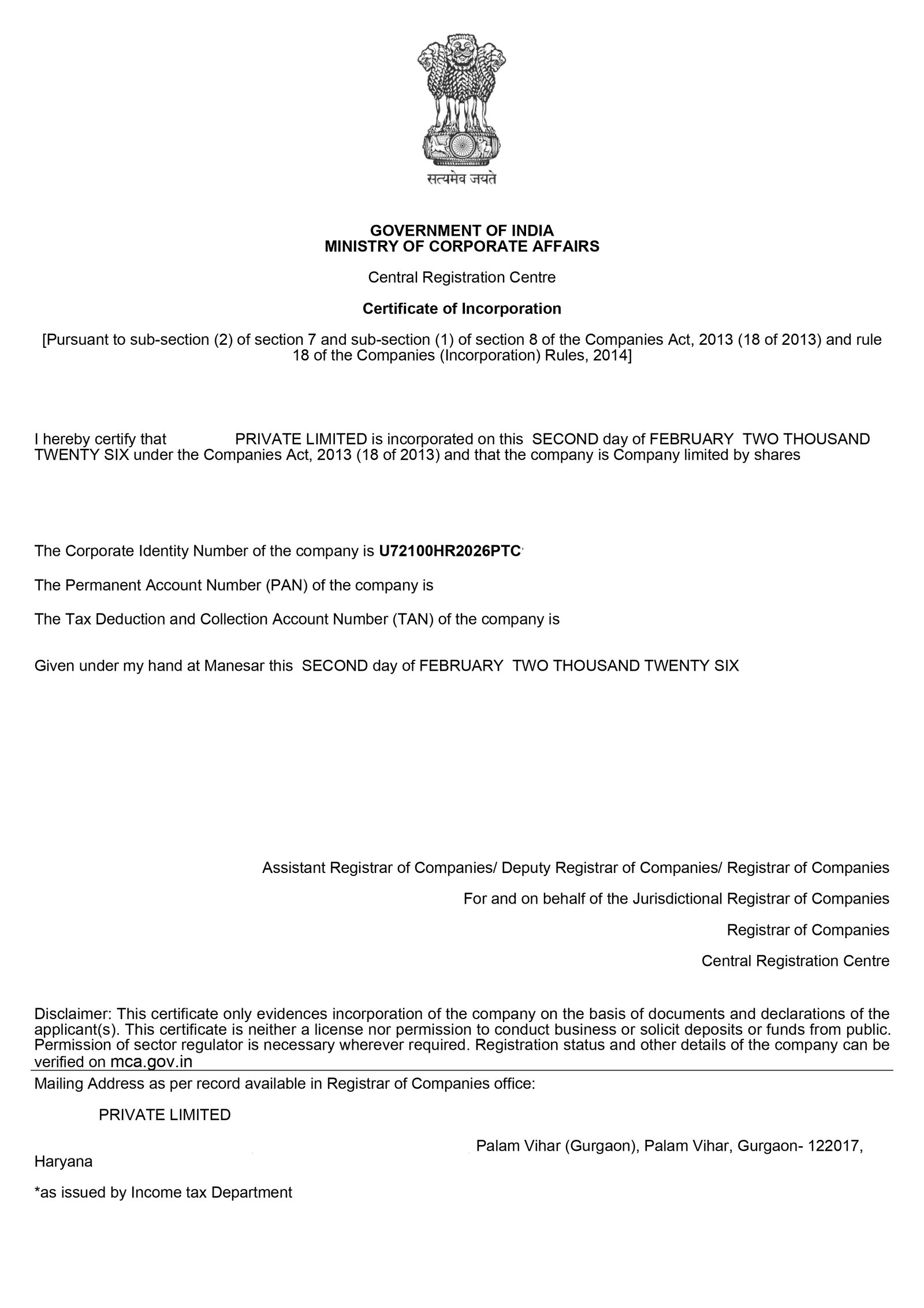
After your Private Limited Company is successfully registered with the Ministry of Corporate Affairs (MCA), you’ll receive a Certificate of Incorporation, also known as the COI. This official document confirms that your company has been legally formed under the Companies Act, 2013. The COI includes your company’s legal name, Corporate Identification Number (CIN), date of incorporation, and registered office details. It’s a crucial document that proves your company’s legal existence. You’ll need the COI for several business activities, such as:
- Opening a business bank account
- Registering for GST
- Entering into legal contracts
- Applying for licenses and permits depending on your sector. This may include FSSAI registration, import export code registration, or other industry-specific approvals.
- Seeking funding or attracting investors
Having a valid COI builds trust with customers, government authorities, and potential partners.
How to Get a Registration Number for a Private Limited Company?
After your company is registered with the Ministry of Corporate Affairs (MCA), you will receive a Certificate of Incorporation. This certificate includes your Corporate Identification Number (CIN), which serves as the official registration number of your private limited company.
Steps to Get a Private Limited Company Registration Number:
- Get DSC and DIN – Apply for a Digital Signature Certificate and Director Identification Number for all proposed directors.
- Choose and submit a Company Name – Submit your name choice to MCA through the SPICe+ or RUN form for approval.
- Fill and submit the SPICe+ Form – Provide company details like business address, directors, and capital, etc.
- MCA Reviews Your Application – The government verifies the documents and details.
- Receive Your Certificate of Incorporation – Once approved, MCA issues the certificate along with your CIN.
Your CIN is used in all legal, tax, and compliance matters. It is also needed for opening a company bank account, filing GST, or managing annual compliance such as income tax return filing.
How to Download the Private Limited Company Registration Certificate?
If you need a digital copy of your company’s Certificate of Incorporation, here’s how to get it:
- Visit the MCA Portal: Go to www.mca.gov.in.
- Log in to your account: Use your registered username and password (Business/Registered User account).
- Go to the ‘MCA Services’ section: Click on “Get Certified Copies” or “View Public Documents.”
- Search for your company: Enter your company’s CIN or full name to locate it.
- Pay the applicable fee (if any): Some documents may have a nominal fee for download.
- Download the COI: Once the document is ready, download the Certificate of Incorporation in PDF format.
- Keep it safe: Save the file and print a copy for your company records.
This certificate is often requested during audits, legal filings, or when applying for official approvals, so it’s important to have it readily accessible.
How to Check Private Limited Company Registration Status?
To check whether your Private Limited Company is registered in India, follow these simple steps:
- Visit the MCA website: Go to www.mca.gov.in.
- Access the Company Master Data: Click on “MCA Services” in the main menu, then select View Company/LLP Master Data.
- Enter company details: Type in your company’s name or Corporate Identification Number (CIN).
- Complete the CAPTCHA and submit: Enter the verification code and click “Submit.”
- Check the status: You’ll see key information such as the company’s registration number, date of incorporation, current status (active, inactive, etc.), and registered address.
If you run into any issues or need help, you can contact the MCA helpdesk or visit the Registrar of Companies (ROC) office.
Ready to Start Your Company?
Let our experts handle the registration process for you. Get started today!
Frequently Asked Questions (FAQs)
What is the difference between a Director and a Shareholder?
A Director is responsible for managing the day-to-day affairs of the company, while a Shareholder is an owner of the company who has invested capital. In a private limited company, a person can be both a director and a shareholder.
Can a foreign national be a director in an Indian Private Limited Company?
Yes, a foreign national can be a director. However, it is mandatory to have at least one director who is a resident of India.
Is it mandatory to have a physical office?
You must have a registered office address in India. This address can be a commercial space or even a residential address, provided you have the necessary NOC from the owner. You can also opt for a virtual office address.
What are the minimum requirements to register a Private Limited Company in India?
A minimum of 2 directors and 2 shareholders are required. One director must be an Indian resident, and the company must have a registered office address in India.
How long does Private Limited Company registration take?
The registration process generally takes around 7–15 working days, depending on document verification and MCA approval.
What documents are required for Private Limited Company registration?
Basic documents include PAN Card, Aadhaar Card/Passport, address proof, passport-size photographs, and registered office proof.
Can a salaried person become a director in a Private Limited Company?
Yes, a salaried person can become a director, provided their employment agreement does not restrict it.
What are the annual compliance requirements for a Private Limited Company?
A Private Limited Company must file annual returns, maintain accounting records, conduct board meetings, and file Income Tax Returns regularly.