 Formsy
Foreign Subsidiary Company Registration in India
Expand to India with ease. Formsy manages your subsidiary registration, compliance, and incorporation—expertly tailored to your parent company's business structure and growth strategy.
- Quick online process—get registered in 20-25 business days
- Legal recognition by the MCA
- Boost credibility and fundraising opportunities
- Seamless registration support at affordable pricing
- COI, MOA, AOA, DIN, PAN TAN, DSC
- Most trusted choice for startups and SMEs
Enter your details to receive a full quote and consultation

What is Foreign Subsidiary in India?
Foreign subsidiary company registration in India is the process of establishing a separate legal business entity under the Companies Act 2013, where a foreign parent company holds 50% or more equity shares. This Indian subsidiary incorporation creates an independent company with its own legal identity, enabling international businesses to expand operations, access the Indian market, and establish a local presence while maintaining control through majority ownership.
A wholly owned subsidiary (WOS) represents 100% foreign ownership, while a partially owned subsidiary involves 50-99% foreign stake. The foreign subsidiary operates as a distinct legal entity capable of owning property, entering contracts, and conducting business independently under Indian law. Unlike branch offices or liaison offices, a foreign subsidiary company in India enjoys full operational flexibility for manufacturing, trading, and service activities while complying with FDI regulations and sectoral guidelines.
Benefits of Setting up a Foreign Subsidiary Company in India
India's rapid economic growth, liberalized FDI policy, and business-friendly reforms make it an ideal destination for global enterprises. Establishing a foreign subsidiary in India is now the preferred market entry strategy, offering complete ownership, operational independence, and access to one of the world's largest consumer markets.
- 100% Ownership and Complete Control: A wholly-owned foreign subsidiary enables the parent company to maintain full operational and strategic control with 100% share ownership under the automatic FDI route in most sectors. This structure eliminates the need for local partners, allowing rapid decision-making, protection of proprietary strategies, technology transfer, and preservation of global brand identity without external approval delays.
- Legal Protection and Limited Liability: Your subsidiary operates as a separate legal entity, ensuring the parent company's global assets remain completely safeguarded from Indian liabilities, debts, or legal disputes. Risk exposure is strictly limited to your investment in the subsidiary, providing a critical corporate shield for international operations.
- Access to 1.4+ Billion Consumers: India is the fifth-largest economy globally with explosive growth potential. A rapidly expanding middle class with increasing purchasing power creates massive demand for products and services. Your subsidiary gains direct market penetration capabilities in this dynamic consumer landscape.
- World-Class Talent at Competitive Costs: India's workforce is young, educated, English-speaking, and skilled across technology, engineering, management, and manufacturing sectors. Foreign subsidiaries can recruit top-tier talent at significantly reduced operational costs compared to developed nations.
- Government Support and Incentives: India actively encourages foreign investment through flagship initiatives like Make in India, Start-up India, and Ease of Doing Business reforms. Foreign subsidiaries are eligible for SEZ benefits, export promotion schemes, tax holidays, reduced corporate tax rates, and subsidies in target sectors.
- Enhanced Local Credibility and Market Trust: Operating as a registered Indian company demonstrates long-term commitment to the market, building stronger relationships with local customers, vendors, employees, and government authorities. Indian incorporation significantly strengthens brand credibility compared to foreign entities. Protecting the local brand through trademark can strengthen that market trust further.
- Tax Optimization Through Double Taxation Treaties: India maintains Double Tax Avoidance Agreements (DTAAs) with 90+ countries, ensuring profits are taxed only once. Foreign subsidiaries enjoy a 22% base corporate tax rate (approximately 25.17% effective rate including surcharge and cess), with potential benefits from transfer pricing strategies and profit repatriation structures. New manufacturing companies may qualify for a concessional 15% tax rate (approximately 17.16% effective rate) under specific conditions.
- Access to Domestic Capital and Financing: Being classified as a domestic Indian entity, your subsidiary can raise capital from Indian banks, financial institutions, and capital markets without foreign exchange exposure. This significantly reduces financing costs and provides diverse funding options for scaling operations.
- Operational Flexibility and Business Freedom: Unlike branch or liaison offices, foreign subsidiaries enjoy unlimited operational scope including manufacturing, trading, services, e-commerce, import-export, and government contract bidding. This unrestricted business freedom enables diversified revenue streams and strategic expansion.
- Simplified Regulatory Framework: Foreign subsidiaries follow straightforward Companies Act 2013 compliance requirements rather than complex foreign entity regulations. Digital incorporation processes, single-window clearances, and streamlined approvals reduce administrative overhead and accelerate market entry.
- Strategic Hub for South Asian Expansion: A subsidiary in India functions as a perfect base for entering neighboring markets including Nepal, Bangladesh, Bhutan, and Sri Lanka. Leverage India's regional trade networks and geographic advantages for broader South Asian growth.
- Intellectual Property and Innovation Protection: Indian subsidiaries can register and protect intellectual property under Indian jurisdiction through services such as trademark registration, facilitating technology transfer, R&D operations, and innovation-driven growth.
Types of Foreign Subsidiary
• Wholly Owned Subsidiary (WOS)
The foreign parent company owns 100% of the shares in the Indian entity, ensuring complete ownership, control, and profit distribution. This is possible only in sectors where 100% foreign direct investment (FDI) is permitted.
• Partially Owned Subsidiary
The foreign parent holds more than 50% but less than 100% of the shares. Remaining shares are held by Indian partners or minority shareholders. This is used in sectors with FDI caps or when forming strategic partnerships.
• Joint Venture Subsidiary
Ownership and control are shared between the foreign parent and Indian partners. The foreign entity may hold a majority or minority share, depending on the agreement and sector-specific FDI rules.
• Limited Liability Subsidiary
Created specifically to ensure shareholder liability is restricted to their investment; it is a structural feature rather than a separate category, often implemented in both wholly-owned and joint venture models.
• Liaison Office
Not technically a subsidiary but often considered an initial step for foreign companies wanting a presence in India. It cannot earn income and is limited to market research, promoting parent company interests, and acting as a communication channel.
• Branch Office
Also not a subsidiary but allows foreign companies to carry out certain business activities in India directly, such as trading and consultancy, under strict RBI guidelines. It is not an independent legal entity like a subsidiary.
Most foreign businesses prefer the wholly owned or joint venture subsidiary option for full operational capability, local presence, and access to India’s massive market, choosing based on FDI policy, sector, and expansion goals.
Eligibility for Foreign Subsidiary Company
Before you begin the foreign company subsidiary registration process in India, you need to meet some basic requirements. These rules are set by the Indian government to ensure that all companies operate properly. Let's look at the key requirements in simple terms.
1. Director Requirements
- A private limited subsidiary must have a minimum of two directors.
- Minimum Directors: You need at least two directors to form a private limited subsidiary.
- Resident Director: At least one of the directors must be an Indian resident. A resident is a person who has lived in India for at least 182 days in the previous calendar year. This person does not have to be an Indian citizen. A foreign national living in India can also be the resident director.
2. Shareholder Requirements
Shareholders are the owners of the company. They invest money in the company by buying shares.
- Minimum Shareholders: You need a minimum of two shareholders.
- Second Shareholder: To fulfill this minimum requirement, the second shareholder can be either an individual or a corporate nominee appointed by the foreign parent company. This means the foreign parent can nominate a person or another company related to it to hold shares on its behalf.
- Parent Company as Shareholder: For a subsidiary, the foreign parent company will be the main shareholder. Another person or entity (from the parent company or a nominee) can be the second shareholder to meet the minimum requirement.
- 100% Foreign Ownership: For a wholly-owned subsidiary, the parent company and its nominee will hold all the shares.
3. Capital Requirements
This is about the money invested in the company to start its business.
- No Minimum Capital: There is no minimum capital requirement by law to start a private limited subsidiary in India. You can start with any amount you feel is sufficient for your business.
- Authorized Capital: You must state an "authorized capital" in your company documents. This is the maximum amount of capital the company is allowed to raise. You can increase it later by paying a fee. There is no fixed limit, but it is common to start with an authorized capital of ₹1,00,000 (around $1,200).
4. Registered Office Requirement
Every company in India must have an official address. This is called the registered office.
- A Physical Address: The registered office must be a physical address in India. It cannot be a P.O. box. This is where all official letters and notices from the government will be sent. Businesses that do not yet have long-term commercial premises may consider a compliant virtual office address, where suitable and acceptable for registration documentation.
- Can Be Rented or Owned: You can use a rented property or a property you own as the registered office.
- Timing: You don't need to have this address on day one of the process. However, you must have it before you apply for registration, and the company must have it within 30 days of being officially formed.
Meeting these foundational requirements is the first step in the registration process for a foreign subsidiary in India.
Documents Required for Foreign Subsidiary Company
To complete the registration, you will need to gather several documents. It is best to prepare these in advance to avoid delays. The documents must be clear, valid, and properly certified.
Here is a simple checklist of what you'll need.
1. Documents from the Foreign Parent Company
- Certificate of Incorporation: Certified copy from the home country, apostilled or notarized.
- Charter Documents: Apostilled copies of Memorandum and Articles of Association (MoA and AoA) or similar.
- Board Resolution: Apostilled formal resolution authorizing India subsidiary setup, naming authorized representative, and confirming investment amount.
2. For Foreign Directors and Shareholders
- Proof of Identity: Apostilled and notarized passport copy.
- Proof of Address: Apostilled and notarized recent bank statement, utility bill, or driver’s license.
- Photograph: Passport-size photo.
- Business Visa: Required if the director will work in India.
3. For the Indian Resident Director
- PAN Card: Copy of Permanent Account Number.
- Aadhaar Card: Copy of Aadhaar.
- Proof of Identity and Address: Passport, voter ID, or driver’s license, plus a recent bank statement or utility bill.
4. For Registered Office Address in India
- Proof of Premises: Rent agreement, or sale deed/property deed.
- No Objection Certificate (NOC): Letter from property owner allowing use of premises.
- Utility Bill: Recent utility bill (within two months) for address proof.
How to Register a Foreign Subsidiary Company in India?
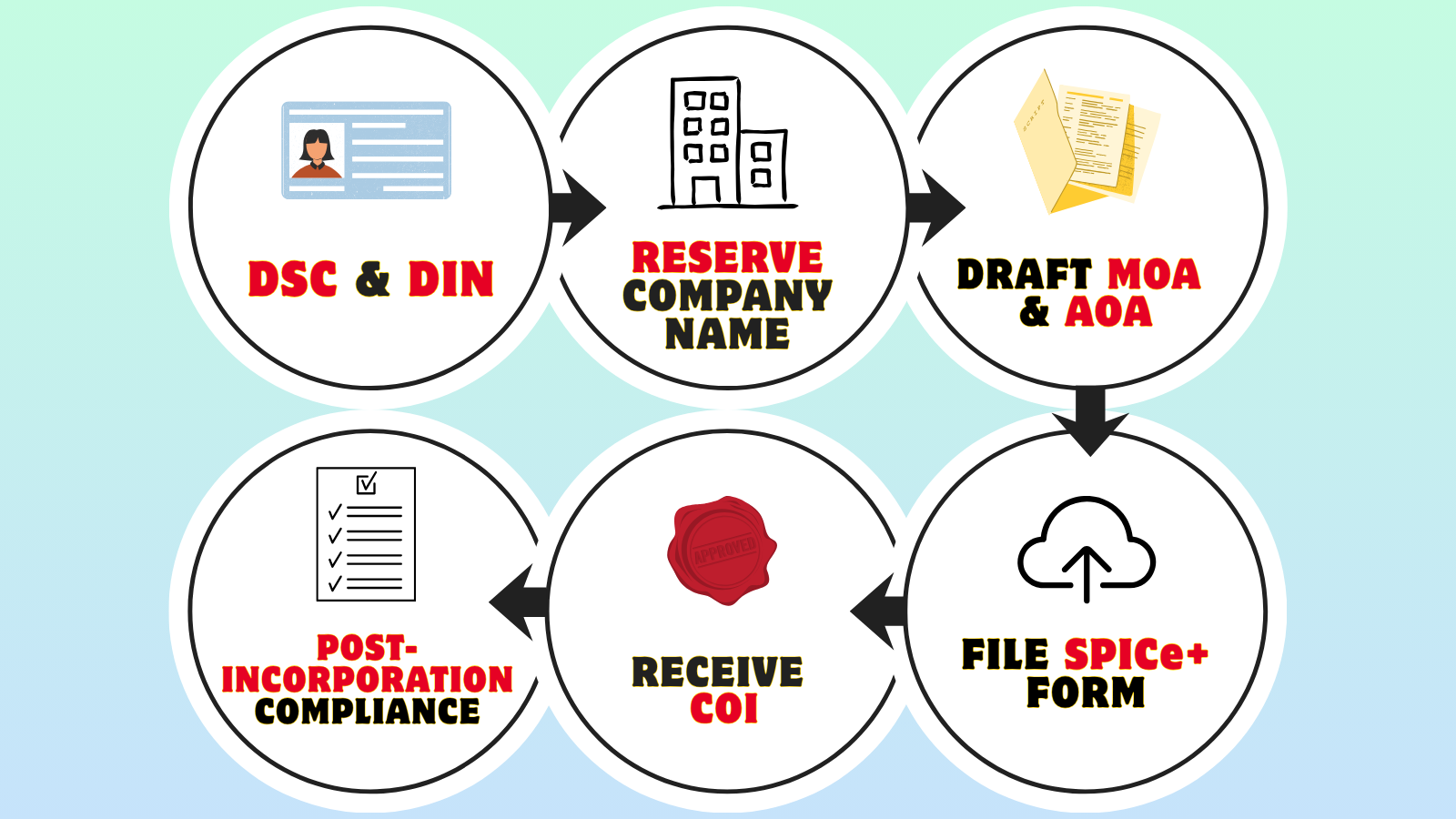
The Indian government has significantly simplified the process of incorporating a subsidiary through modern online platforms, making it faster, more transparent, and user-friendly. Here’s a step-by-step guide to help you register a subsidiary of a foreign company in India with ease:
-
Obtain Digital Signature Certificate (DSC) and Director Identification Number (DIN)
All proposed directors must obtain a Digital Signature Certificate (DSC) for secure electronic signing during company registration. A unique Director Identification Number (DIN) is mandatory for each director—both are essential for initiating subsidiary company setup in India. -
Reserve Unique Company Name (RUN Service)
Use the MCA’s Reserve Unique Name (RUN) service to select and secure a company name for your foreign company subsidiary. The name should ideally reflect the foreign parent company and must comply with the MCA guidelines before final approval. -
Draft Memorandum and Articles of Association (MoA & AoA)
Prepare the company’s Memorandum of Association (MoA) (object clauses, business purpose) and Articles of Association (AoA) (internal governance rules). For foreign subsidiaries, these must also be signed by the parent company representatives. -
File SPICe+ Integrated Incorporation Form
Submit the SPICe+ (Simplified Proforma for Incorporating Company Electronically Plus) form online for company incorporation. This comprehensive form covers company registration, DIN application, PAN, TAN, GSTIN, EPFO, and ESIC registrations, ensuring efficient compliance for foreign subsidiaries in India. -
Certificate of Incorporation (COI)
Upon approval, MCA will issue the Certificate of Incorporation (COI)—the official proof of legal subsidiary registration in India. The COI includes automatic allotment of PAN and TAN for the company. -
Post-Incorporation Compliance & RBI Reporting
After registration, open a corporate bank account, deposit shareholder capital, and file Form INC-20A (declaration of commencement of business) within 180 days. Report foreign direct investment to the Reserve Bank of India (RBI) to comply with FDI rules and ensure regulatory adherence.
Following the Foreign Company Subsidiary Registration process in India carefully will ensure a hassle-free start for your business.
Foreign Subsidiary Company vs Indian Subsidiary Company
| Basis | Foreign Subsidiary Company | Indian Subsidiary Company |
|---|---|---|
| Ownership Structure | Foreign parent company holds more than 50% shares; majority from outside India |
Indian parent company holds more than 50% shares; majority from Indian entities |
| Parent Company Documentation |
Requires apostilled/notarized foreign documents (certificate of incorporation, board resolution, MOA/AOA) |
Uses standard Indian company documents; simpler documentation process |
| Director Requirements | Minimum one Indian resident director mandatory; foreign directors permitted without PAN |
Can have all Indian directors; more flexible director structure |
| FDI & Regulatory Approval |
Subject to FDI policy, sectoral caps, and restricted country provisions; may need RBI clearance |
No FDI restrictions; direct domestic investment; streamlined approvals |
| Tax Rate | 22% corporate tax (same as Indian subsidiaries); double taxation treaty benefits apply |
22% corporate tax rate; similar tax treatment |
| Capital Infusion & FEMA | Foreign capital requires FIRC (Foreign Inward Remittance Certificate) and RBI compliance |
Domestic capital—no FEMA compliance or FIRC needed |
| Market Credibility & Brand Identity |
Can retain parent company name with "India" suffix; showcases foreign connection |
Creates independent Indian identity; easier local brand building |
| Profit Repatriation | Subject to tax compliance and FEMA regulations; repatriation allowed post-tax payment |
Dividends distributed to Indian parent; no foreign exchange restrictions |
Post Compliance Requirements for a Foreign Subsidiary Company
Registering your company is just the beginning. To operate legally in India, you must follow certain rules and deadlines called compliance. Not following these rules can lead to heavy fines and penalties. Here is a simple checklist of compliances for a subsidiary of a foreign company in India.
Immediate Actions (Within the First 180 Days)
- First Board Meeting: Hold the first meeting of the Board of Directors within 30 days of incorporation.
- Appoint First Auditor: The Board of Directors must appoint the company's first statutory auditor within 30 days. The company must then file Form ADT-1 with the Registrar of Companies (ROC) to notify them of the appointment.
- Open Bank Account: Open a corporate bank account immediately after receiving the Certificate of Incorporation.
- Deposit Share Capital: Ensure all shareholders deposit their promised share money into the company’s bank account.
- File Declaration of Commencement of Business (Form INC-20A): This is a must. File the INC-20A form with the ROC within 180 days of incorporation to declare that the share capital has been received. You cannot start your business activities until this is filed.
RBI & FEMA Compliances
Since there is foreign investment involved, you must report it to the Reserve Bank of India under the Foreign Exchange Management Act (FEMA).
-
Form FC-GPR (Foreign Collaboration - General Permission Route): This form must be filed within 30 days of receiving the share investment from the foreign parent company. This form reports the details of the foreign direct investment to the Reserve Bank of India through its online Foreign Investment Reporting and Management System (FIRMS) portal.
The company must obtain a valuation report from a certified valuer (such as a Chartered Accountant or SEBI-registered Merchant Banker) to certify the fair value of the shares issued. This ensures compliance with RBI regulations and transparency in share allotment and investment details. - FLA Return (Foreign Liabilities and Assets): This is an annual return that must be filed by July 15th every year. It details all the foreign investments (both received and made) by the Indian company.
Annual ROC and Tax Filings
Every year, you need to file certain documents with the Registrar of Companies (ROC) and the Income Tax Department.
- Annual General Meeting (AGM): Hold an AGM with your shareholders every year.
- Form AOC-4: File your company's financial statements (Balance Sheet, Profit & Loss Account) with the ROC.
- Form MGT-7: File your company's Annual Return with the ROC. This contains details about directors, shareholders, etc.
- Income Tax Return: File the company's income tax return with the tax department by the due date.
- Tax Audit: If your company's turnover exceeds ₹1 crore in a financial year, you need to get your accounts audited by a Chartered Accountant under Section 44AB of the Income Tax Act (the limit increases to ₹10 crore if at least 95% of your business transactions are digital). Additionally, companies with FDI must comply with transfer pricing norms and file Form 3CEB if applicable.
Staying on top of this compliance for foreign subsidiaries under the Companies Act 2013 and other laws is key to long-term success.
Foreign Subsidiary Company Registration Certificate
Once your Company gets registered with the Ministry of Corporate Affairs (MCA), you receive a Certificate of Incorporation (COI). This certificate confirms the legal formation of your company under the Companies Act, 2013.
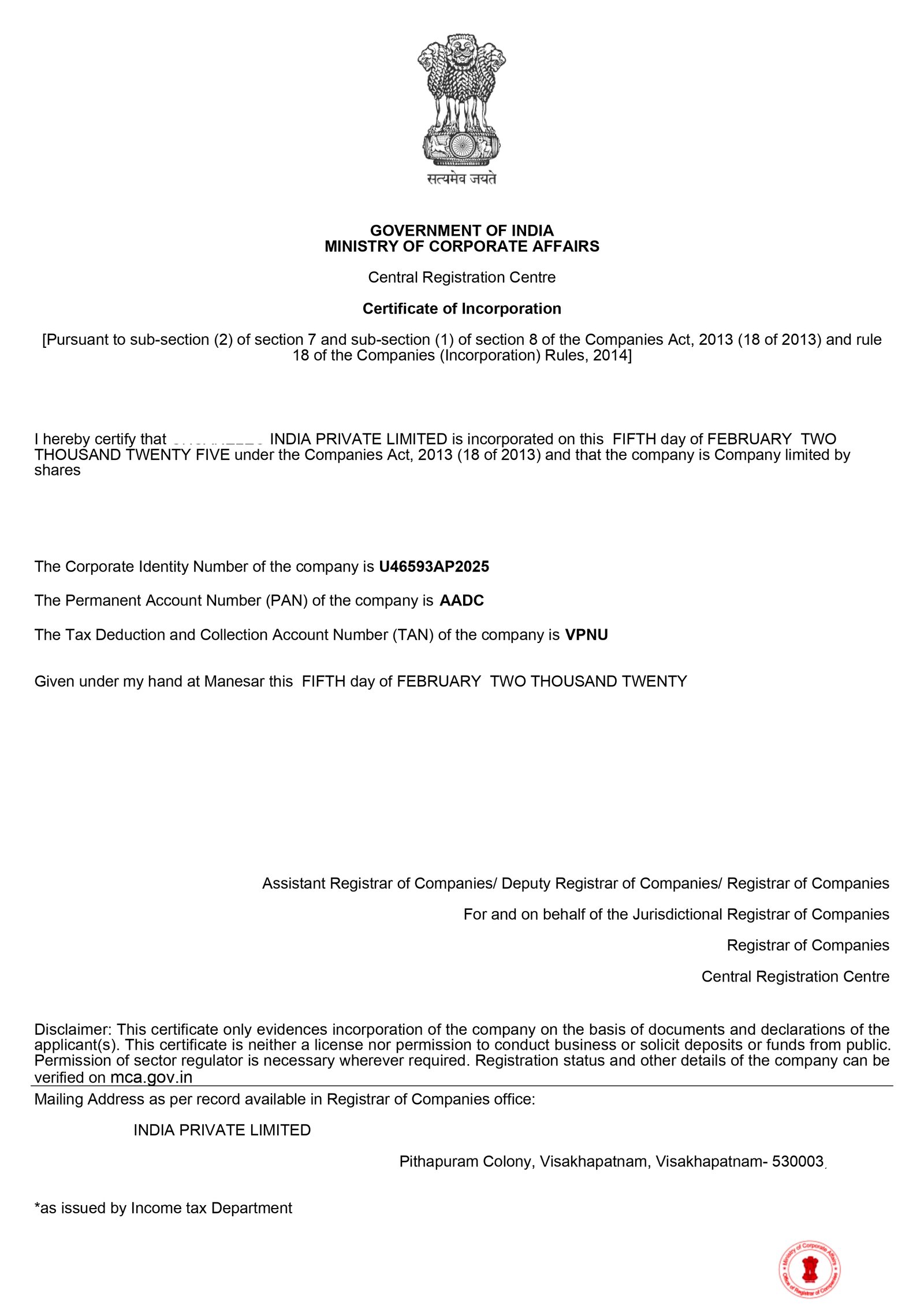
The COI includes your company’s legal name, Corporate Identification Number (CIN), date of incorporation, and registered office details. It’s a crucial document that works as proof of company registration in India for your business.
You’ll need the COI for several business activities, such as:
- Opening a business bank account
- Registering for PAN, TAN, and GST
- Entering into legal contracts
- Applying for licenses and permits
- Seeking funding or attracting investors
Having a valid certificate of incorporation of a Foreign Subsidiary Company builds trust with customers, government authorities, and potential partners.
How to Download the Certificate of Incorporation for a Foreign Subsidiary Company?
If you need a digital copy of your company’s Certificate of Incorporation, here’s how to get it:
- Visit the MCA Portal: Go to www.mca.gov.in.
- Log in to your account: Use your registered username and password (Business User account).
- Go to the ‘MCA Services’ section: Click on “Get Certified Copies” or “View Public Documents.”
- Search for your company: Enter your company’s CIN or full name to locate it.
- Pay the applicable fee (if any): Some documents may have a nominal fee for download.
- Download the COI: Once the document is ready, download the Certificate of Incorporation in PDF format.
- Keep it safe: Save the file and print a copy for your company records.
This certificate is often requested during audits, legal filings, or when applying for official approvals, so it’s important to have it readily accessible.
How to Check the Status of Foreign Subsidiary Company Formation?
To check whether your Company is registered in India, follow these simple steps:
- Visit the MCA website: Go to www.mca.gov.in.
- Access the Company Master Data: Click on “MCA Services” in the main menu, then select “View Company/LLP Master Data.”
- Enter company details: Type in your company’s name or Corporate Identification Number (CIN).
- Complete the CAPTCHA and submit: Enter the verification code and click “Submit.”
- Check the status: You’ll see key information such as the company’s registration number, date of incorporation, current status (active, inactive, etc.), and registered address.
If you run into any issues or need help, you can contact the MCA helpdesk or visit the local Registrar of Companies (RoC) office.
Need Help with Foreign Subsidiary Registration?
Let our experts handle the complete incorporation and compliance process for you.
Frequently Asked Questions (FAQs)
What documents are needed from the foreign parent company?
Certificate of incorporation (apostilled), board resolution authorizing subsidiary formation, MOA and AOA (apostilled/notarized), and recent financial statements—all translated to English if in other languages.
Do foreign directors need a PAN card?
No, PAN card is not mandatory for foreign directors; only Indian resident directors require PAN and Aadhaar cards.
What authentication is required for foreign documents?
All foreign documents must be apostilled or notarized in the country of origin and translated into English if originally in another language.
Can the foreign parent company use the same name in India?
Yes, the foreign parent company can use the same name with "India" or "Indian" suffix for the subsidiary.
What is the Indian resident director requirement?
At least one director must be an Indian resident, defined as a person who has stayed in India for 182 days or more in the previous calendar year.
Are there FDI restrictions for certain sectors?
Yes, some sectors require government approval route instead of automatic route, and investments from countries sharing land borders with India require prior government approval.
What is Form 20A?
Declaration of commencement of business, filed within 180 days of incorporation after receiving subscription money from the parent company.
Do I need FIRC for capital infusion?
Yes, Foreign Inward Remittance Certificate (FIRC) is required as proof of foreign capital received from the parent company.
What is the typical business structure used?
Private Limited Company is the most common and recommended structure for foreign subsidiaries in India.
Can profits be repatriated to the parent company?
Yes, profits can be repatriated to the foreign parent company subject to RBI guidelines and applicable taxes.