 Formsy
Indian Subsidiary Company Registration Online
Establish your Indian subsidiary seamlessly. Formsy delivers end-to-end registration, regulatory compliance, and expert guidance aligned with your parent company's global vision.
- Quick online process—get registered in 20–25 business days
- Legal recognition by the MCA
- Boost credibility and fundraising opportunities
- Seamless registration support at affordable pricing
- COI, MOA, AOA, DIN, PAN TAN, DSC
- Most trusted choice for startups and SMEs
Enter your details to receive a full quote and consultation

What is an Indian Subsidiary Company?
Indian subsidiary company registration refers to the incorporation of a new company under the Companies Act 2013, where an existing Indian or foreign parent company holds at least 50% of the share capital, creating a separate legal entity with independent operations and management. This subsidiary company incorporation in India establishes a distinct business structure that operates under the parent company's brand while maintaining its own legal identity for compliance, taxation, and liability purposes.
An Indian subsidiary functions as an independent company with separate financial records, statutory obligations, and management structure, despite the parent company's controlling stake through equity ownership. The subsidiary can be either a wholly owned subsidiary (WOS) where the parent holds 100% shares, or a partially owned subsidiary with 50-99% parent ownership. This corporate structure enables business expansion, market diversification, and operational flexibility while protecting the parent company through limited liability provisions. Businesses comparing entity options may also consider private limited company registration depending on ownership and funding structure.
Key Features of Indian Subsidiary Company
In India, a subsidiary company is considered a separate legal entity from its parent company, even if the parent holds a majority stake. This means the subsidiary has its own identity, can sign contracts, own property, and be taken to court independently.
- Separate Legal Entity: An Indian subsidiary operates as an independent legal entity distinct from its parent company, with its own rights and obligations under the Companies Act 2013. This means the subsidiary can own property, enter contracts, sue and be sued in its own name, and conduct business operations independently.
- Parent Company Control: The parent company holds 50% or more equity shares in the subsidiary, providing control over strategic decisions and management. In a wholly owned subsidiary (WOS), the parent maintains 100% ownership and complete operational control over decision-making and financial matters.
- Limited Liability Protection: The parent company's liability is limited to the capital invested in the subsidiary. Global assets of the parent remain shielded from Indian liabilities, ensuring financial protection and risk isolation.
- Unique Company Name: The subsidiary can have its own unique trading name and does not need to bear the parent company's name. This allows independent brand building and market positioning tailored to the Indian consumer base.
- Independent Statutory Documentation: The subsidiary must apply for its own business licenses, PAN, TAN, GST registration, and maintain separate statutory documents including MOA and AOA. It operates with its own Certificate of Incorporation and Corporate Identification Number (CIN). It may also need supporting registrations such as MSME registration or trademark registration depending on business strategy.
- Domestic Company Status: Despite foreign ownership, the subsidiary is treated as a domestic Indian company under the Income Tax Act and Companies Act 2013. This classification provides access to local business opportunities and regulatory benefits available to Indian companies.
- Full Operational Freedom: Unlike branch or liaison offices, Indian subsidiaries enjoy complete operational flexibility to engage in manufacturing, trading, service delivery, and full-scale business activities without requiring multiple RBI approvals.
- Separate Taxation: The subsidiary files independent tax returns and is subject to corporate tax on its worldwide profits, typically at a 22% tax rate (plus surcharge and cess) for eligible companies. Tax obligations remain separate from the parent company's liabilities.
- Independent Financial Reporting: The subsidiary maintains separate financial records, conducts mandatory statutory audits regardless of turnover, and files annual financial statements with the Registrar of Companies.
- No Minimum Capital Requirement: There is no mandatory minimum paid-up capital for private limited subsidiary companies in India, providing flexibility in capital structure based on business needs.
Indian Subsidiary Company vs Private Limited Company
| Basis | Indian Subsidiary Company | Private Limited Company |
|---|---|---|
| Ownership & Control | Parent company holds more than 50% equity; strict control relationship |
Ownership determined by shareholding percentage; flexible structure |
| Parent Company Documentation |
Requires parent company documents (certificate of incorporation, board resolution, MOA/AOA) |
No parent company documents needed; independent entity |
| Inter-company Transactions |
Better suited for funding transfers and transactions between parent and subsidiary |
Not ideal for regular inter-company funding; may create tax complexity |
| Name Registration | Higher probability of retaining parent company's name (with "India" suffix) |
Lower chance of using parent company name; requires unique identity |
| Tax Rate | 22% corporate tax rate for both structures; same taxation treatment |
22% corporate tax rate under Section 115BAA; identical tax burden |
| FDI Eligibility | 100% FDI allowed based on activity and sector restrictions |
100% FDI allowed based on activity; more flexible in most sectors |
| Market Credibility | Explicitly showcases foreign parent relationship; builds trust through subsidiary status |
Professional private limited structure; strong brand perception and investor confidence |
| Compliance & Audit | Mandatory audit regardless of turnover; standard compliance obligations |
Mandatory audit for all companies; higher regulatory requirements |
Types of Subsidiary Companies in India
| Types | Ownership | Control | Key Features | Suitable For |
|---|---|---|---|---|
| Wholly Owned Subsidiary (WOS) |
Parent owns 100% shares |
Complete operational control |
Full strategic autonomy, maximum decision-making power, requires 100% FDI sector eligibility |
Companies seeking total control and IP protection |
| Partially Owned Subsidiary |
Parent owns 50-99% shares |
Majority control with minority shareholders |
Shared ownership, collaborative decision-making, reduced capital burden |
Risk diversification and local partnerships |
| Joint Venture Subsidiary |
Two or more companies share ownership |
Shared control between partners |
Pooled resources, shared risks, access to local expertise and networks |
Market entry with local partner support |
| Foreign Subsidiary |
Foreign parent holds more than 50% shares |
Parent controls from outside India |
Subject to FDI regulations, requires apostilled documents, one Indian resident director mandatory |
International expansion into Indian market |
| Domestic Subsidiary |
Indian parent holds more than 50% shares |
Domestic parent control |
No FDI restrictions, simpler documentation, domestic capital infusion |
Indian companies expanding operations |
| Branch Office | Extension of parent company |
Direct parent company control |
Not a separate legal entity, requires RBI approval, can conduct trading activities |
Limited commercial operations |
| Liaison Office | Non-commercial unit | Parent oversight only | Cannot generate revenue, used for market research and coordination only |
Market research and feasibility studies |
Eligibility for Indian Subsidiary Company Registration
To register a subsidiary in India, you need at least two shareholders, two directors (one must be a resident of India), and a registered office in the country.
There is no fixed minimum capital needed to set up the subsidiary.
- Shareholders: At least two shareholders are needed. These can be individuals, foreign companies, or a mix of both.
- Directors: You must appoint a minimum of two directors. At least one of them must live in India.
- Registered Office: A valid physical address in India is needed as the registered office. If the space is rented, a No Objection Certificate (NOC) from the property owner is required. Businesses without a long-term leased premises may consider a compliant virtual office address, where suitable and acceptable for registration documentation.
- No Minimum Capital: There is no specific minimum capital required to start a subsidiary company in India.
- Equity Share Capital: In some cases, the foreign parent company must hold at least 50% of the equity share capital in the Indian subsidiary.
Documents Required for Indian Subsidiary Company Registration
To register a subsidiary company in India, you need to collect documents related to the company, its directors, and its registered office.
1. Company-Related Documents
- Memorandum of Association (MOA) and Articles of Association (AOA): These are key documents that explain the company’s goals, shareholding details, and internal rules and regulations.
-
Proof of Registered Office: You need to show that your business has a physical office in India. This can be:
- A rental agreement is required if the space is leased
- Ownership documents are required if the company owns the property
- Recent utility bills (electricity, water, phone) as supporting address proof
- No Objection Certificate (NOC): If the office is rented, the landlord must provide a letter (NOC) permitting the use of the space as the company’s registered office.
- Certificate of Incorporation: If the parent company is a foreign entity, you need to submit its Certificate of Incorporation to prove its legal existence.
- Board Resolution of the Parent Company: The parent company must officially approve the formation of the Indian subsidiary through a board resolution.
- Capital Structure: Details of how much share capital the company is authorized to issue and how much has already been paid up.
2. Director and Shareholder Related Documents
- Digital Signature Certificate (DSC) and Director Identification Number (DIN): These are mandatory for directors to file forms online and for official identification.
-
Identity and Address Proof:
- For Indian directors and shareholders: PAN card, Aadhaar card, passport, or voter ID and bank statement/utility bill
- For foreign nationals: Passport and proof of address(bank statement), verified by the Indian embassy or notarized/apostilled
- Photographs of Directors and Shareholders: Passport-size photos are needed for identification purposes.
- Declaration by Directors and Shareholders: Each director and shareholder must sign a declaration confirming their consent and eligibility to take part in the company.
How to Register an Indian Subsidiary Company?
Setting up a foreign subsidiary in India involves a few important steps and legal formalities.
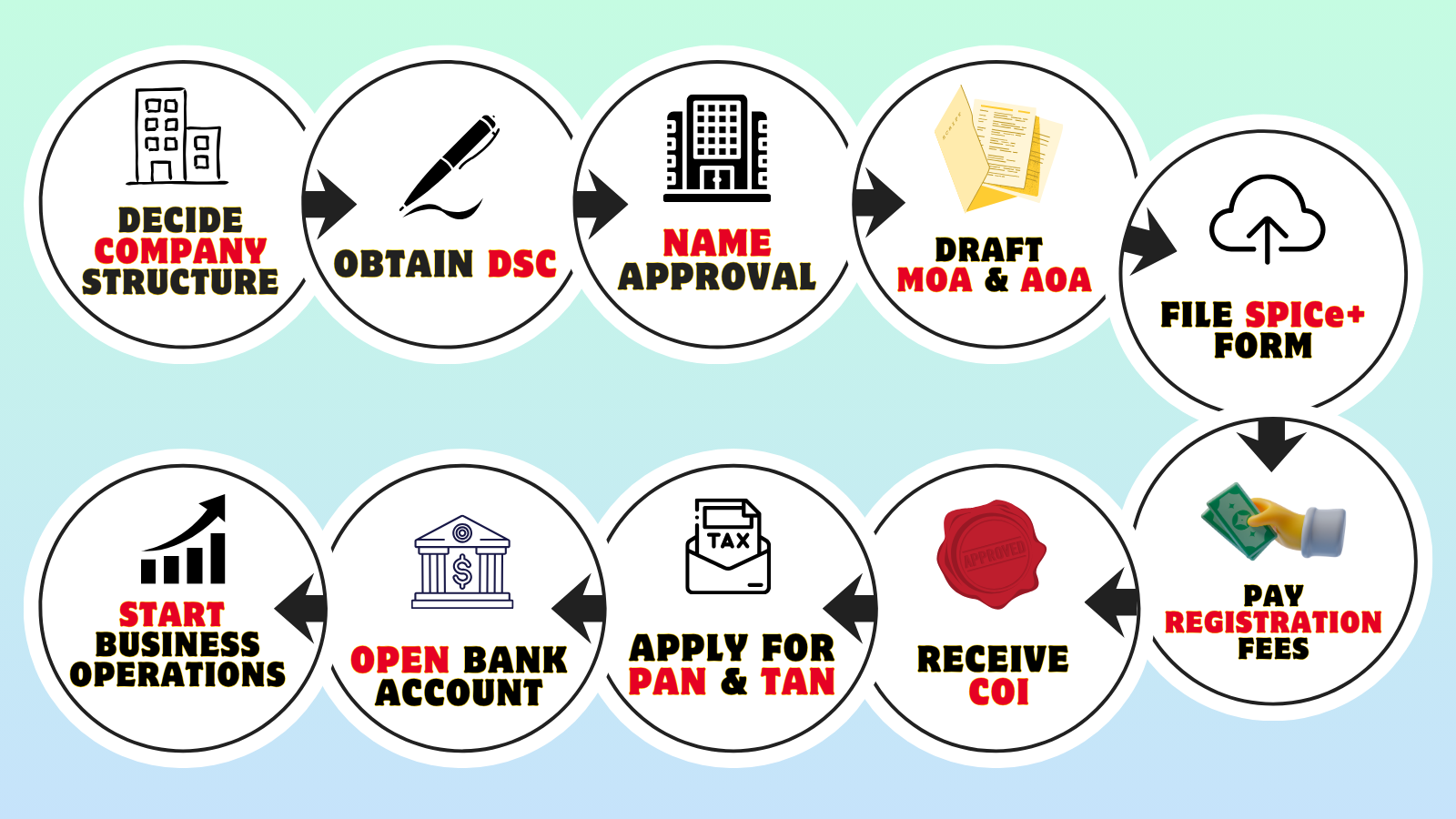
Here's a simple step-by-step guide to help you through the process:
- Decide the Type of Company: First, decide what type of company you want to register as your Indian subsidiary. Most foreign businesses choose a Private Limited Company structure.
- Get Digital Signature Certificates (DSC): Since the registration process is done online, you’ll need a Digital Signature Certificate (DSC) for all proposed directors. This allows them to sign official documents electronically.
- Choose and Get Company Name Approved: Pick a unique name for your subsidiary and apply for name approval through the MCA portal. Make sure the name follows the official naming rules. Once the name is approved, businesses often protect their brand through trademark registration.
- Prepare Memorandum and Articles of Association (MoA & AoA): These are legal documents that define the purpose of the company and how it will run. Draft the MoA and AoA according to the Companies Act, 2013.
- File Incorporation Documents: Once the name is approved, submit the MoA, AoA, and other required forms using the SPICe+ form on the MCA portal. These documents go to the Registrar of Companies (ROC).
- Pay the Registration Fees: You will need to pay a registration fee to the ROC. The amount depends on the company’s authorized share capital.
- Get the Certificate of Incorporation (COI): If all documents are correct, the ROC will issue a Certificate of Incorporation (COI). This officially means your Indian subsidiary is now registered.
- Apply for PAN and TAN: After getting the COI, apply for a Permanent Account Number (PAN) and a Tax Deduction and Collection Account Number (TAN) from the Income Tax Department.
- Open a Bank Account: Open a bank account in the name of the Indian subsidiary to start managing business finances.
- Start Business Operations: Once the company is officially registered and all required steps are complete, your foreign subsidiary can begin doing business in India. After this stage, the company may proceed with GST registration and tax-related setup.
Fees for Registration of Indian Subsidiary Company
The cost to register a subsidiary company in India can vary based on several factors such as the authorized share capital, professional fees, number of directors/shareholders, and state-specific charges.
Government Fees
| Component | Estimated Cost (INR) |
|
|---|---|---|
| Name Reservation (RUN form) |
₹1,000 | The fee for reserving the company name through the MCA portal. |
| SPICe+ Form Filing | ₹143–₹7,000+ | Rs.143 for companies with an authorized capital of up to ₹10 lakh, but increases for higher capital amounts. |
| Stamp Duty | (varies by state) | Depends on the state and authorized capital. |
Note: In addition to incorporation costs, businesses should budget for post-registration requirements such as msme registration, GST registration, and compliance support.
Post-Incorporation Compliance for a Subsidiary Company in India
Once your subsidiary company is registered in India, following all legal and regulatory procedures is essential for compliance and uninterrupted business operations. These mandatory post-incorporation compliances help prevent penalties and ensure your subsidiary stays fully aligned with Indian corporate laws.
- Bank Account Opening: Open a current bank account in the company's name for all business transactions and capital receipts.
- Capital Investment: The parent company must deposit the initial share capital into the subsidiary’s bank account as declared in the incorporation documents.
- Share Certificate Issuance: Issue share certificates to all shareholders (including the foreign parent) within 60 days of incorporation.
- Filing Form FC-GPR (RBI): File Form FC-GPR with the Reserve Bank of India via the FIRMS portal within 30 days of capital receipt from the foreign parent.
- GST Registration (if required): Obtain GST registration if turnover exceeds the statutory limit or if the entity supplies taxable goods/services.
- Professional Tax Registration: Register for Professional Tax where applicable; required in certain states for employee salary processing.
- Shops and Establishment Registration: Register under the Shops and Establishments Act within 30 days of start of operations, depending on state law.
- Accounting & Bookkeeping: Maintain accurate books of accounts in either physical or electronic form as per Indian standards.
- Auditor Appointment (Form ADT-1): Appoint a statutory auditor and file Form ADT-1 with the Registrar of Companies within 30 days of incorporation.
- First Board Meeting: Conduct the inaugural board meeting within 30 days of incorporation to address compliance and key strategic matters.
- Income Tax PAN & TAN: Ensure PAN and TAN are obtained, if not already issued during incorporation, for tax processing and compliance.
-
Annual Compliances: Meet annual filing obligations, including:
- File annual return (Form MGT-7)
- File financial statements (Form AOC-4)
- Hold Annual General Meeting (AGM)
- Form INC-20A (Commencement of Business): File within 180 days of incorporation, confirming receipt of share capital.
Timely completion of these steps will keep your Indian subsidiary fully compliant and positioned for smooth business growth.
Benefits of Indian Subsidiary Company Registration
Setting up a subsidiary in India gives foreign companies many advantages, especially in terms of business growth, legal protection, and operational ease.
- Market Access and Growth: Entering India allows access to a vast, fast-growing market, driving higher sales and regional expansion through localized offerings.
- Financial Benefits: Enjoy tax incentives, lower operational costs, and access to a cost-effective, skilled workforce for smooth scaling.
- Limited Liability: The parent company's liability is limited to its investment, safeguarding its global assets.
- Operational Flexibility: Subsidiaries can make decisions locally and adapt quickly to market needs, improving efficiency.
- Separate Legal Identity: As an independent legal entity, the subsidiary protects the parent company while ensuring compliance with Indian laws.
- Business Diversification: Spreads business risk and enhances global presence by tapping into new sectors and customer bases.
- Strategic Partnerships: Facilitates collaboration with Indian firms, leveraging local expertise and networks.
- Brand Trust and Visibility: A local presence builds credibility with Indian customers and boosts brand reputation. Protecting the brand name through trademark registration can strengthen that credibility further.
- Focused Operations: Enables dedicated teams to concentrate on specific products, services, or markets for better performance.
Indian Subsidiary Company Registration Certificate
Once your Company gets registered with the Ministry of Corporate Affairs (MCA), you receive a Certificate of Incorporation (COI). This certificate confirms the legal formation of your company under the Companies Act, 2013.
The COI includes your company’s legal name, Corporate Identification Number (CIN), date of incorporation, and registered office details. It’s a crucial document that works as proof of company registration in India for your business.
You’ll need the COI for several business activities, such as:
- Opening a business bank account
- Registering for PAN, TAN, and GST
- Entering into legal contracts
- Applying for licenses and permits
- Seeking funding or attracting investors
Having a valid certificate of incorporation of a Subsidiary Company builds trust with customers, government authorities, and potential partners.
How to Download the Certificate of Incorporation for a Subsidiary Company?
If you need a digital copy of your company’s Certificate of Incorporation, here’s how to get it:
- Visit the MCA Portal: Go to mca.gov.in.
- Log in to your account: Use your registered username and password (Business User account).
- Go to the ‘MCA Services’ section: Click on “Get Certified Copies” or “View Public Documents.”
- Search for your company: Enter your company’s CIN or full name to locate it.
- Pay the applicable fee (if any): Some documents may have a nominal fee for download.
- Download the COI: Once the document is ready, download the Certificate of Incorporation in PDF format.
- Keep it safe: Save the file and print a copy for your company records.
This certificate is often requested during audits, legal filings, or when applying for official approvals, so it’s important to have it readily accessible.
How to Check the Status of Subsidiary Company Formation?
To check whether your Company is registered in India, follow these simple steps:
- Visit the MCA website: Go to mca.gov.in.
- Access the Company Master Data: Click on “MCA Services” in the main menu, then select “View Company/LLP Master Data.”
- Enter company details: Type in your company’s name or Corporate Identification Number (CIN).
- Complete the CAPTCHA and submit: Enter the verification code and click “Submit.”
- Check the status: You’ll see key information such as the company’s registration number, date of incorporation, current status (active, inactive, etc.), and registered address.
If you run into any issues or need help, you can contact the MCA helpdesk or visit the local Registrar of Companies (RoC) office.
Need Help with Indian Subsidiary Registration?
Let our experts handle the entire incorporation process for you. Get started today!
Frequently Asked Questions (FAQs)
What is an Indian subsidiary company?
A company incorporated in India under the Companies Act 2013, where a parent company holds 50% or more of the share capital, creating a separate legal entity with independent operations.
Can a foreign company own 100% of an Indian subsidiary?
Yes, 100% foreign ownership is permitted in most sectors under the automatic FDI route without government approval, subject to sectoral caps and restrictions.
What is the minimum capital required?
No minimum paid-up capital is mandated for a private limited subsidiary company in India.
How many directors are required?
Minimum two directors are required, with at least one Indian resident director (residing in India for 182+ days annually).
Do I need to visit India for registration?
No, the entire registration process can be completed online through the MCA portal using digital signatures and document uploads.
How long does the registration take?
The incorporation process typically takes 10 to 15 days from name approval to certificate issuance.
What is the first step in registration?
Reserving a unique company name using the MCA's RUN (Reserve Unique Name) service through the SPICe+ form.
Is a registered office address mandatory?
Yes, a registered office address in India is mandatory, and virtual offices are initially acceptable for registration purposes.
What are the post-incorporation compliance requirements?
Annual ROC filings, statutory audit, minimum two board meetings annually, one AGM, GST returns, income tax filing, and EPF/ESI registrations.
What is the total cost of incorporation?
Registration costs range from ₹25,000 to ₹1,00,000 depending on professional fees, government charges, and paid-up capital structure.