 Formsy
OPC Registration Online in India
Establish a legally recognized company structure with single ownership and complete control. Formsy is the go-to platform for startups and small business owners.
- Fast OPC Incorporation in Just 8-10 business Days
- Seamless Company Name Approval
- Incorporation certificate, MOA, AOA, PAN, TAN Delivered
- DIN Allotment for the Company Director
- Digital Signature Certificate (DSC) with Full Support
Enter your details to receive a full quote and consultation

What is One Person Company Registration?
A One Person Company (OPC) is a business structure introduced under the Companies Act, 2013, that allows a single Indian citizen and resident to form a private limited company type structure for solo founders. It gives the sole owner full control while offering limited liability, separate legal status, and perpetual succession. OPCs must appoint a nominee who will take over if the owner dies.
Combining the simplicity of a sole proprietorship with limited liability, an OPC has a single owner who acts as both shareholder and director, with a nominee appointed for succession. Initiated by a promoter, it is a separate legal entity that can own assets and enter into contracts.
Key features of a One Person Company in India
An OPC is designed to combine the simplicity of sole proprietorship with the benefits of a company structure. Key characteristics include:
- Single Member Ownership: An OPC is formed and owned by a single individual who is both the shareholder and director, making it ideal for solo entrepreneurs.
- Separate Legal Entity: The OPC is a distinct legal entity, separate from its owner, meaning the company can own assets and enter into contracts in its own name.
- Limited Liability: The owner’s liability is limited to the extent of their shareholding, protecting personal assets from business debts and liabilities.
- Perpetual Succession: The company continues to exist even if the owner dies or becomes incapacitated, with a nominee stepping in automatically.
- Nominee Requirement: A nominee must be appointed at the time of registration to take over in case the sole member can no longer manage the company.
- Restricted Share Transfer: Shares cannot be freely transferred to outsiders; the sole member holds complete ownership until the company is converted into a private or public limited company.
Key Laws, Regulations & Authorities Governing One Person Companies in India
Understanding the legal framework is crucial. One Person Company registration and operation in India are primarily governed by a comprehensive set of laws:
- Companies Act, 2013: The primary legislation governing all aspects of company formation, operation, dissolution, and corporate governance standards.
- Income Tax Act, 1961: Regulates the taxation aspects of private limited companies, including corporate tax rates, deductions, and filing obligations.
- Goods and Services Tax (GST) Laws: Mandatory GST registration is required for companies crossing specified turnover thresholds.
- Information Technology Act, 2000: Applies to companies engaging in electronic commerce and digital business activities.
Key Regulatory Authorities for One Person Companies
Your journey to establish and operate a One Person Company involves interaction with several critical government bodies:
- Registrar of Companies (ROC): Under the Ministry of Corporate Affairs, the ROC processes your SPICe+ application and issues the Certificate of Incorporation.
- Income Tax Department: Manages corporate tax filings, including income tax return requirements.
Types of One Person Company in India
Looking to register a One Person Company (OPC) in India? Explore the best options available:
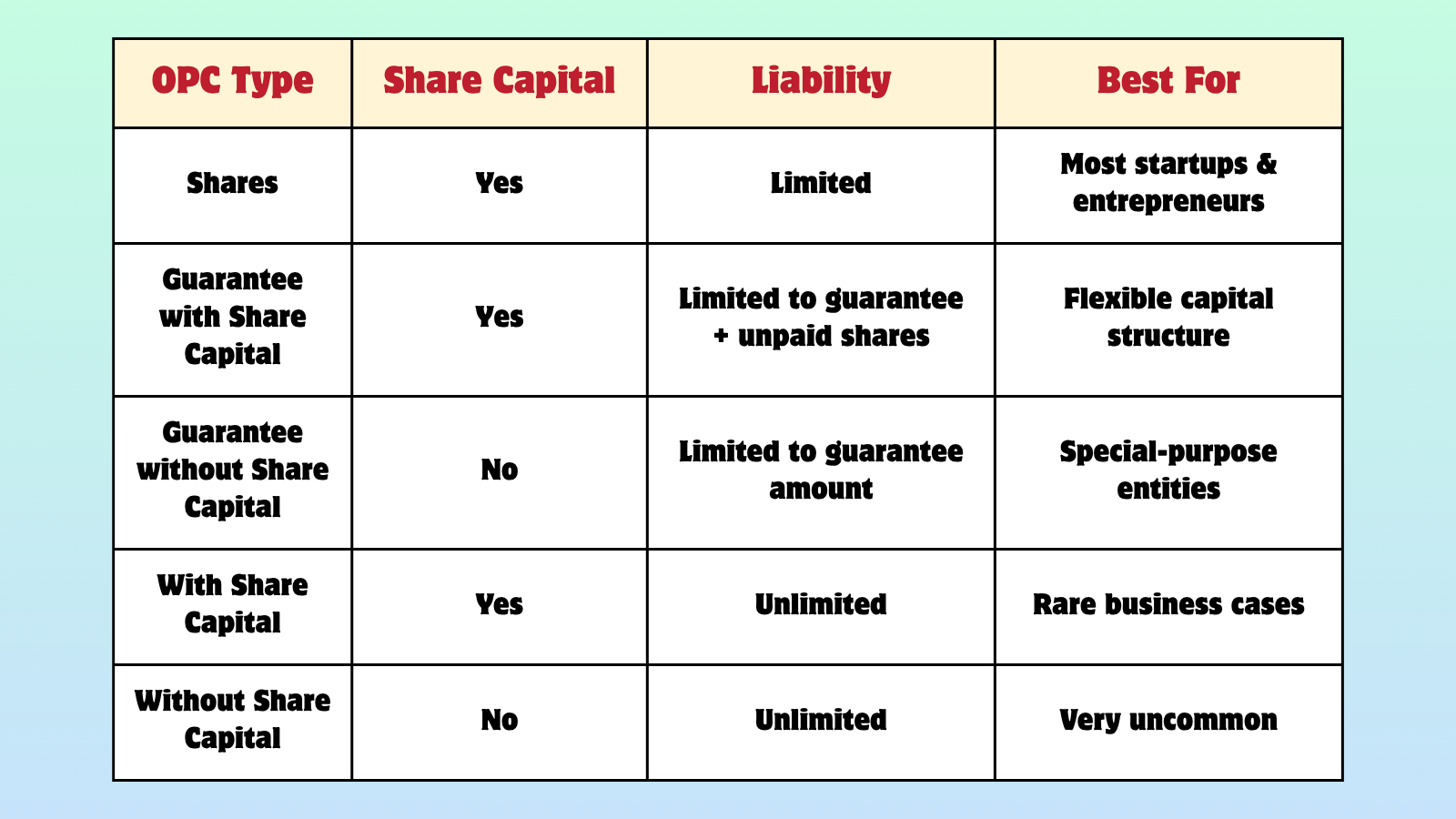
- OPC Limited by Shares: It falls under Section 2(22) & 2(68). Your liability stays limited to your unpaid share value. This gives you solid protection from business debts. This is the most popular option amongst entrepreneurs for OPC registration. Entrepreneurs comparing entity types may also evaluate private limited company or sole proprietorship depending on their growth plans and compliance needs.
- OPC Limited by Guarantee with Share Capital: This type combines shares with a guarantee clause. Your liability includes both unpaid shares and the guaranteed amount. It offers a flexible capital structure.
- OPC Limited by Guarantee without Share Capital: This type, under Section 2(21), creates an entity without shares. Your liability is based only on your contribution guarantee if the company shuts down.
- Unlimited OPC with Share Capital: This type includes share capital but offers no liability protection. You remain personally responsible for all company debts. High-risk option, but with flexible capital handling.
- Unlimited OPC without Share Capital: This has neither share capital nor liability protection. You face unlimited personal responsibility. Very few choose this due to the high personal risk.
These structures are recognized under Indian company law, but only OPC Limited by Shares is widely used in practice—others exist for specific scenarios or legacy reasons.
Eligibility Criteria for One Person Company Registration
To successfully register a One Person Company in India, specific statutory requirements must be fulfilled. Here’s a breakdown of the key eligibility criteria:
- Minimum Directors: A minimum of one director is mandatory for company registration.
- Resident Director Requirement: The director must be an Indian Resident and a citizen, having stayed in India for a minimum of 182 days in the preceding financial year.
- Maximum Directors: A One Person Company can appoint up to 15 directors by default.
- Shareholders: Only one shareholder is required for incorporation. Importantly, the same individual can hold both director and shareholder positions.
- Registered Office: The company must have a physical registered office in India. This address will be used for all official government communications and requires valid address proof, along with a No Objection Certificate (NOC) from the property owner of the premises. Businesses that do not have a commercial premises yet may also consider using a virtual office address where suitable and compliant.
- No Minimum Paid-up Capital: There is no mandatory minimum paid-up capital requirement. However, the company must declare its authorized share capital, for which a government fee is applicable during registration.
- Director Identification Number (DIN): The director must obtain a unique Director Identification Number (DIN), issued by the Ministry of Corporate Affairs (MCA).
- Digital Signature Certificate (DSC): The director is required to obtain a Class 3 Digital Signature Certificate (DSC). It is used for digitally signing incorporation documents during the registration process.
Documents Required for One Person Company Registration
The documents required for One Person Company registration include identity proof, address proof, and registered office proof, among others, which are as follows:
1. For Member/Director
- PAN Card and Aadhaar Card (Identity proof)
- Recent passport-sized photographs
- Government-issued ID (Passport, Driving License, Ration Card, or Voter ID)
- Proof of residence (Recent utility bills, bank statements not older than 2 months)
- Digital Signature Certificate (DSC)
2. For Nominee
- PAN Card and Aadhaar Card
- Recent photographs
- Signed consent letter to act as a nominee
- Identity and address proof documents same as the director
3. For Business Address
- Proof of registered office (Utility bills, NOC from landlord, or rental agreement). If you are operating remotely, a compliant virtual office address may also help satisfy registered office requirements, subject to documentation rules.
- Consent letter (Authorization to use the address as the registered office)
4. Additional Documents
- Director Identification Number (DIN) (obtained during registration)
- Declaration of intended business activities
- Memorandum of Association (MOA)
- Articles of Association (AOA)
5. Forms
- Form SPICe+A: For name reservation.
- Form SPICe+B: For incorporation of the OPC.
- Form INC20A: For filing the commencement of business after incorporation.
Post- Registration Compliances of OPC
Once an OPC is registered, it must comply with several legal and regulatory requirements to maintain its active status. The company needs to file annual returns and financial statements with the Ministry of Corporate Affairs (MCA) every year. Additionally, the OPC should hold regular board meetings and maintain statutory registers and records. Depending on the nature of the business, GST registration and other licenses may also be required to ensure full compliance.
- Board Meetings: Hold at least two meetings every year, with at least 90 days between them. Keep detailed minutes of these meetings for your records.
- Virtual Office: You can use a compliant virtual address as your registered office in case you do not have a business place. Make sure it allows proper board meetings and record keeping as required by law.
- Tax Filing: After registration, an OPC must file its income tax returns annually for tax compliance. It should also deduct TDS where applicable and file GST returns if its turnover exceeds the prescribed limit.
- GST Registration and Compliance: If you're registered under GST, file regular returns showing all your sales and purchases. Keep your GST returns updated to avoid penalties.
How to Register a One Person Company in India?
To register a One Person Company in India, file the required incorporation forms with the Ministry of Corporate Affairs along with the necessary documents and fees.
 in India.png)
- Name Reservation: Your company name matters a lot while registering an OPC. Pick about two unique name options that represent your business well. Check if they're available on the website of MCA before proceeding. Remember, your name must end with "(OPC) Private Limited" to follow the rules. Once your company name is finalized, you may also want to protect it through trademark registration.
- Obtain DSC and DIN: You'll need digital signatures for One Person Company Registration paperwork. Apply for a Digital Signature Certificate (DSC) through authorized agencies. Submit your ID and address proofs as required. Once you get your DSC, apply for a Director Identification Number (DIN) through the registration process.
- Prepare and File Incorporation Documents: Now comes the paperwork part of the OPC Registration. Draft your Memorandum of Association (MOA) describing your company's business objective. Create Articles of Association (AOA) outlining your internal rules. Fill out Form INC-9 (First director declaration) and Form INC-3 (Nominee consent). Submit everything through the SPICe+ form on the MCA website. Double-check all details to avoid delays in your One Person Company Registration.
- Pay Registration Fees: You'll need to pay several fees for OPC Registration. Calculate the government fee based on your capital. Add state stamp duty according to local rules. Include professional fees if you're using professional services. All OPC registration fees must be paid to incorporate your OPC.
- Verification and Certificate Issuance: After submission, officials review your OPC Registration application carefully. The Registrar of Companies checks all documents for compliance with the law. If everything looks good, they issue your Certificate of Incorporation. This officially establishes your OPC with a unique Corporate Identity Number (CIN), PAN, and TAN.
- Post-Registration Setup: Once your OPC Registration is complete, set up essential business systems. Get company seals and letterheads with your company registered name. Open a business bank account using your incorporation certificate. Apply for GST registration for tax purposes. Set up proper accounting and record-keeping systems.
Want more details? Connect with our expert team and get a complete guide on how to register a One Person Company (OPC) in India.
Ready to Start Your Company?
Let our experts handle the registration process for you. Get started today!
Benefits of One Person Company Registration
OPCs offer several advantages that make them an attractive choice for small business owners and startups:
- Complete Control with Legal Protection: The sole owner has full control over decisions while enjoying limited liability protection, reducing personal financial risk.
- Simplified Compliance: OPCs have fewer regulatory requirements and annual compliance obligations compared to private limited companies, reducing administrative hassle and costs.
- Continuity and Stability: Perpetual succession ensures the company’s uninterrupted existence, which builds trust with customers and investors.
- Easier Access to Funding: OPCs can raise capital through loans or investments, providing better opportunities to grow compared to sole proprietorships.
- Credibility and Trust: Being a registered company enhances the business’s credibility with clients, vendors, and financial institutions.
- Tax Advantages: OPCs often benefit from corporate tax rates and can avail certain government incentives and subsidies meant for registered companies. Eligible businesses may also explore Startup India registration and MSME registration for added benefits.
OPC Certificate, Number & Status Check
One Person Company Registration Number
The One Person Company (OPC) Registration Number is a unique alphanumeric identifier assigned by the Registrar of Companies (ROC) upon successful incorporation of the OPC in India. This registration number provides legal recognition to the OPC as a separate legal entity under the Companies Act, 2013, enabling it to operate independently from its sole owner. This number must be quoted on all official documents, contracts, invoices, government filings, and correspondence to ensure the company’s authenticity and maintain transparency along with related compliance references such as GST registration details where applicable..
OPC Incorporation Certificate
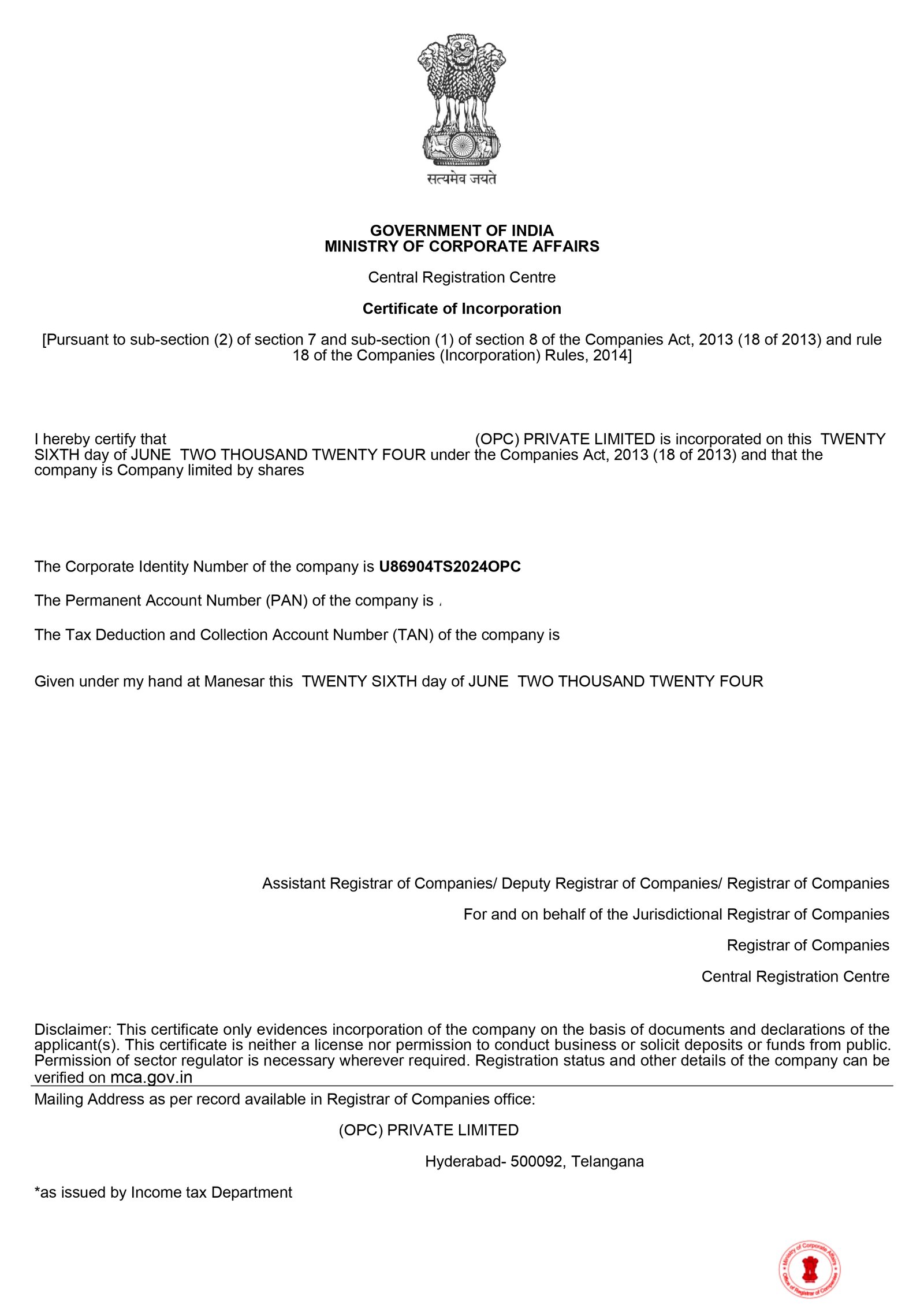
An OPC Registration Certificate is the official legal document that certifies the incorporation of the company under the Companies Act, 2013. It acts as conclusive proof that the company has been legally formed and recognized by the ROC. This certificate contains vital information such as the company’s name, registration number, date of incorporation, and the registered office address. It must be safely stored and presented during official and legal proceedings. This certificate is also commonly used when applying for GST registration, opening bank accounts, and starting statutory compliance.
How to Download the OPC Registration Certificate Online?
- Visit the official MCA website: mca.gov.in
- Navigate to the ‘MCA Services’ section and select ‘View Company/LLP Master Data’ or ‘Download Certificate.’
- Enter the company name or registration number.
- Complete the CAPTCHA and submit your request.
- The registration certificate will be available to view and download in PDF format.
How to Check an OPC Registration Status Online?
- Go to the MCA portal or the Registrar of Companies’ website.
- Select ‘Track Application Status’ or ‘View Company Status.’
- Enter your application number or company registration number along with the date of filing.
- View real-time updates on the status of your application, such as under review, approved, or pending documents.
How long does it take to register a One Person Company?
Registering a One Person Company (OPC) in India generally takes around 8 to 10 working days. The key timeline breakdown is:
- Day 1–2: Digital Signature Certificate (DSC) application
- Day 2–3: Director Identification Number (DIN) application
- Day 3–5: Company name reservation with MCA
- Day 5–8: Filing incorporation forms and supporting documents
- Day 9–10: Issuance of Certificate of Incorporation (COI)
Note: Registration timelines may vary based on case complexity, document completeness, and MCA workload.
Fees for One Person Company Registration in India
The fees for One Person Company registration in India vary based on authorized capital and include government filing charges, DSC, DIN, and professional service costs, as follows:
Registration Costs
- Name Reservation Fee: Rs. 1,000 for filing the name reservation form.
- Digital Signature Certificate: Rs. 2,500 - Rs. 3,000 per director, depending on validation level and provider.
- DIN/DPIN Application: Rs. 500 per director.
- Stamp Duty for OPC Registration: Varies by state and the authorized capital during the registration, typically ranging from 0.1% to 1% of the capital contribution.
Note: The fees mentioned above don’t cover the charges an OPC registration consultant might take for their services.
Need Help with Your OPC?
Our team is here to guide you through every step. Contact us for expert advice.
Frequently Asked Questions (FAQs)
Can an OPC have more than one director?
Yes, a One Person Company can appoint up to 15 directors by default. However, it can only have one shareholder.
Can a foreign citizen start an OPC in India?
No. To start an OPC, the individual must be a natural person, an Indian citizen, and a resident of India.
What happens if the sole owner of an OPC dies?
A nominee is appointed at the time of registration. In case of the owner's death or incapacitation, the nominee takes over the company, ensuring perpetual succession.
Is there a minimum capital required to start an OPC?
No, there is no mandatory minimum paid-up capital requirement for registering an OPC in India.
Who is eligible to register an OPC in India?
Only a natural person who is an Indian citizen and resident in India can register a One Person Company (OPC).
How long does OPC registration take?
OPC registration generally takes around 7–15 working days, depending on document verification and MCA approval.
What documents are required for OPC registration?
Required documents include PAN Card, Aadhaar Card/Passport, address proof, passport-size photograph, and registered office proof.
Can an OPC be converted into a Private Limited Company?
Yes, an OPC can be converted into a Private Limited Company by fulfilling the applicable legal requirements under the Companies Act.
Is GST registration required for an OPC?
GST registration is required only if the OPC’s turnover exceeds the prescribed limit or if it falls under mandatory GST registration criteria.