 Formsy
LLP Registration Online in India
Start Your LLP Journey Today—Smart Setup, Zero Hassle, and Complete Legal Protection seamlessly with Formsy Experts at affordable pricing.
- Quick online process—get registered in 10–12 business days
- Legal recognition by the MCA
- Boost credibility and tax benefits
- LLP name approval, DPIN, PAN, TAN, COI, DSC
- Reliable & Trusted by Indian Startups
- LLP Agreement Draft
Enter your details to receive a full quote and consultation

What is an LLP?
The Limited Liability Partnership (LLP), a business structure that combines the flexibility of a partnership with the limited liability protection of a company. It offers a separate legal identity, meaning partners aren’t personally liable for the firm’s debts.
LLPs are a preferred choice for startups and professionals who want shared management, minimal compliance, and legal protection without putting personal assets at risk.
Key Features of a Limited Liability Partnership
- Separate Legal Entity: An LLP enjoys the status of a separate legal entity, meaning it can own assets, enter contracts, and sue or be sued in its own name—just like a private limited company. This ensures accountability and legal protection for all partners.
- Minimum Two Designated Partners Required: To establish an LLP, at least two individuals/body corporates must join as designated partners for day-to-day management and compliance. These partners can be individuals or corporate bodies, allowing flexibility in forming professional or business collaborations.
- One Resident Partner Rule: Out of the designated partners, at least one must be a resident and a citizen of India. This is a mandatory legal requirement for registration and ensures local accountability.
- Limited Liability Protection: Each partner’s liability is limited to their agreed contribution in the LLP. In case of business losses or debts, partners’ personal assets remain protected—a major advantage over traditional partnerships.
- Cost-Effective Business Structure: LLP formation is more affordable compared to private limited companies. It offers the benefits of incorporation without the heavy cost or complex procedures with respect to compliances.
- Low Compliance Requirements: LLPs are known for their simplified regulatory and compliance norms. Annual filings and audit obligations are minimal, making it easy to manage even for small and medium businesses.
- No Minimum Capital Requirement: There is no need for a minimum capital contribution to start an LLP. Partners can begin operations with any amount they agree upon, giving them complete financial flexibility.
Understanding Limited Liability Partnership Registration
Limited Liability Partnership (LLP) has become a preferred form of organization among entrepreneurs in India. An LLP incorporates the benefits of a partnership firm and a company. As the name suggests, an LLP is a partnership firm established by a minimum of two partners who enter into an LLP agreement. However, the partners of an LLP have limited liability and the LLP has perpetual succession just like a company.
The concept of the Limited Liability Partnership (LLP) was introduced in India in 2008. The Limited Liability Partnership Act, 2008 regulates the LLPs in India. Minimum two partners are required to incorporate an LLP. However, there is no upper limit on the maximum number of partners of an LLP.
Among the partners, there should be a minimum of two designated partners who must be natural persons, and at least one of them should be resident in India. The rights and duties of designated partners are governed by the LLP agreement. They are directly responsible for the compliance of all the provisions of the LLP Act, 2008 and provisions specified in the LLP agreement.
Objectives of the LLP Registration in India
The objective of registering an LLP is to establish a legal business entity that provides limited liability protection while maintaining operational flexibility.
- Limited Liability Protection: Shield partners' assets from business liabilities.
- Legal Entity Formation: Create a separate legal entity distinct from its partners.
- Operational Flexibility: Enjoy the benefits of minimal compliance requirements compared to other companies.
- Perpetual Succession: Ensure business continuity regardless of changes in partnership.
- Tax Benefits: Avail of favorable tax treatment compared to private limited companies. Businesses may also strengthen credibility through MSME registration and Startup India registration where eligible.
- Business Credibility: Enhance reputation and credibility with clients, vendors, and financial institutions.
- Capital Contribution Flexibility: Allow partners to contribute capital as agreed without minimum capital requirements.
- Simplified Compliance: Benefit from fewer regulatory requirements compared to other companies.
Laws and Rules Governing LLP Registration in India
LLP registration in India follows legal rules that ensure the proper setup and operation of these business entities.
- Limited Liability Partnership Act, 2008: Provides the foundational legal framework for the formation, operation, and dissolution of LLPs in India, ensuring compliance with necessary legal formalities.
- Limited Liability Partnership Rules, 2009: Details procedural aspects, including registration, conversion, and compliance requirements, offering clarity on the operational steps for LLPs.
- Companies Act, 2013 (for conversion): Contains provisions relating to the conversion of companies into LLPs, offering a legal pathway for businesses to transition from a company structure to an LLP.
- Foreign Exchange Management Act, 1999: Regulates foreign investment in LLPs and the establishment of LLPs with foreign partners, ensuring proper compliance with foreign exchange policies. Businesses involving foreign ownership may also evaluate foreign subsidiary company registration in India or Indian subsidiary company registration, depending on the structure.
- Income Tax Act, 1961: Outlines the taxation framework applicable to LLPs, including income tax return filing obligations defining how LLPs are taxed and what deductions or exemptions they can claim under Indian tax laws.
Types of LLP Registration in India
Before we get into how to incorporate an LLP, let’s first know about the options available to register as one. These forms of registration come in various types to accommodate different categories of businesses and operational needs:
- Domestic LLP: For businesses operating within India with Indian partners. Example: Two individuals in Delhi forming an LLP to provide marketing services across India.
- Foreign LLP: For LLPs with foreign partners or foreign LLCs establishing a place of business in India. Example: A US-based consulting firm establishing an LLP in India with both Indian and American partners. In some cases, businesses may also compare this route with foreign subsidiary company registration in India.
- Startup LLP: For innovative business ventures seeking recognition under the Startup India initiative. Example: Three engineers forming an LLP to develop a new mobile application with innovative features.
- Small LLP: For businesses with lower turnover and capital contribution thresholds. Example: A small manufacturing business with a turnover of less than Rs. 30 lakhs forming an LLP. Such businesses may also benefit from MSME registration.
- Conversion to LLP: For existing partnerships or companies converting to the LLP structure. Example: An existing partnership firm dealing in food and beverages converting to an LLP structure for limited liability benefits.
Every registered LLP receives a Certificate of Incorporation as official proof of registration.
Eligibility Criteria for LLP Registration Online
Before learning about the LLP incorporation procedure, it’s essential to know whether your business qualifies for it or not. Eligibility for registering an LLP depends on several factors as per the Limited Liability Partnership Act, 2008.
- Minimum partners - At least two members are required to form an LLP (individuals or bodies corporate).
- Designated Partners - Minimum two designated partners who are individuals, with at least one being a resident of India.
- Residency Requirement - At least one designated partner must have resided in India for at least 182 days during the preceding year.
- Age requirement - All partners and designated partners must be at least 18 years of age.
- No maximum limit - There is no maximum limit on the number of partners in an LLP.
- Digital Signature Certificate (DSC) - All designated partners must possess a valid DSC.
- Director Identification Number (DIN) - All designated partners must have a valid DIN or DPIN.
- Prohibited sectors - LLPs cannot be registered for non-profit activities or in sectors prohibited by the government.
Meeting these statutory and financial requirements necessitates proper LLP registration in India to maintain compliance and avoid penalties.
Documents Required for LLP Company Registration
Before applying, it’s essential to know the complete LLP incorporation checklist. An effective LLP registration requires proper documentation to establish the entity's legal foundation:
1. For Partners & Designated Partners
- PAN cards of all partners
- Identity proof (Passport, Voter ID, Driving License, etc.)
- Address proof (Utility bills, bank statements - not older than 2 months)
- Recent passport-sized photographs
- Proof of residency in India
- Valid Digital Signature Certificates (DSCs)
2. For Business & Financials
- Proof of registered office address (Businesses that do not yet have a commercial space may consider a virtual office address, where appropriate.)
- Consent letter/NOC from the property owner
- LLP Agreement draft
- Capital contribution proof
- Necessary forms like RUN-LLP, FiLLiP, and Form 3
How to Register an LLP Online in India?
Registering an effective LLP requires careful planning and execution. The following are the steps you must know:
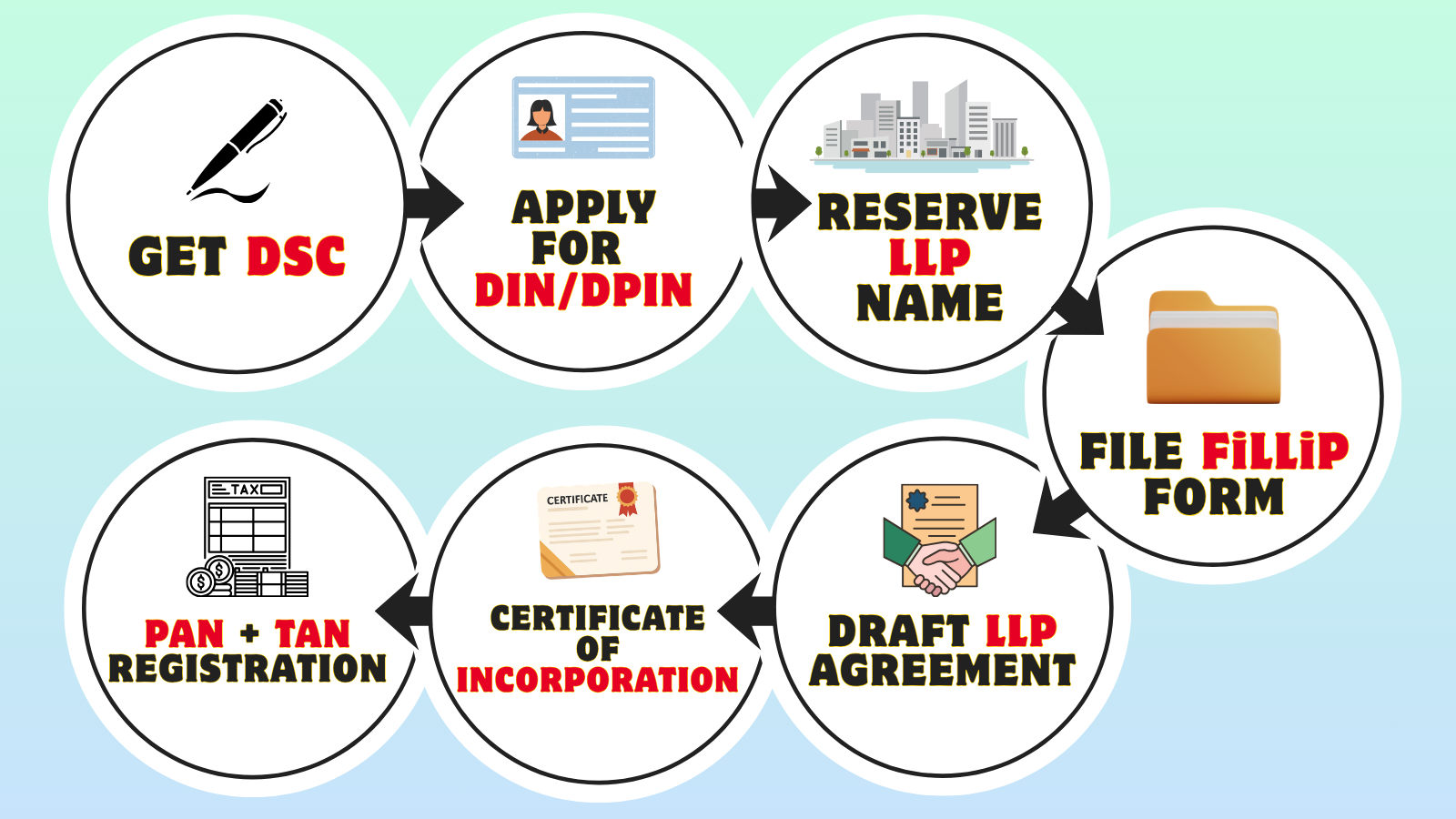
Obtain a Digital Signature Certificate (DSC)
Obtain a DSC for all designated partners to facilitate digital signing of government filings.
Apply for Designated Partner ID Number (DPIN)
Obtain DPIN for all designated partners through Form DIR-3.
Reserve LLP Name
Check name availability and apply through the RUN-LLP form by submitting up to 2 unique name options as per MCA guidelines. Once approved, you may also want to secure your brand through trademark registration.
File Incorporation Documents
Submit Form FiLLiP (Form for Incorporation of Limited Liability Partnership) along with necessary documents, including the Subscriber sheet and consent forms.
Receive Certificate of Incorporation
Upon successful verification, the Registrar issues a Certificate of Incorporation.
Submit LLP Agreement
Draft and file a detailed LLP Agreement through Form 3 on the MCA portal within 30 days of incorporation.
Post-Registration Compliances
Obtain PAN, TAN, open a bank account, register for GST if applicable, and file your income tax return using ITR 5.
Fees & Penalties of LLP Registration in India
Understanding the total cost of LLP registration in India, including government fees, and potential penalties, is essential for entrepreneurs.
| Category | Details & Amounts |
|---|---|
| Registration Costs | |
| Name Reservation Fee | Rs. 200 for filing the RUN-LLP form. |
| Incorporation Fee | Varies from Rs. 643 to Rs. 5,143 based on capital contribution. |
| Digital Signature Certificate | Rs. 2,500 - Rs. 3,000 per partner. |
| DIN/DPIN Application | Rs. 500 per partner. |
| LLP Agreement Drafting | Rs. 3,000 - Rs. 10,000. |
| Note: Fees don't include professional consultation charges. | |
| Penalties for Non-Compliance | |
| Penalties for incorrect or delayed LLP registrations can include fines, interest charges, and legal action. | |
| Late Filing (Form 3, 8, 11) | Rs. 100 per day. |
| Non-Compliance with Provisions | Penalties from Rs. 1,000 to Rs. 5 lakhs. |
| False Statements | Penalties up to Rs. 5 lakhs and potential criminal proceedings. |
Key Characteristics of an LLP Registration
An LLP registration has distinct characteristics that shape how these business entities function:
- Limited Liability Protection: Partners' liability is limited to their agreed contribution, protecting personal assets.
- Separate Legal Entity: LLP exists as a distinct legal entity separate from its partners. This makes it structurally closer to a private limited company than a traditional partnership firm.
- Perpetual Succession: LLP continues to exist regardless of changes in partnership, ensuring business continuity.
- Flexible Capital Contribution: No minimum capital requirement for LLP formation.
- Internal Autonomy: Partners can organize internal operations as per mutual agreement.
- Tax Transparency: Profits are taxed only at the LLP level without dividend distribution tax.
- Ease of Compliance: Simpler regulatory requirements compared to companies.
- Business Scalability: Allows an unlimited number of partners, facilitating business growth and expansion.
Advantages of Registering an LLP
Discover the key benefits of LLP registration in India, from legal protection to tax advantages and greater operational flexibility:
- Limited Liability Protection: Shields partners' assets from business liabilities, limiting financial risk.
- Tax Benefits: Avoids double taxation applicable to companies; no dividend distribution tax.
- Minimal Compliance Burden: Requires fewer statutory compliances. However, businesses must still manage essential filings such as income tax return filing and, where applicable, GST return filing. Audits are only required if turnover exceeds Rs. 40 lakhs.
- Business Continuity: Ensures perpetual succession, meaning the business continues regardless of changes in partnership.
Still exploring your options? You might also want to check out our private limited company registration, sole proprietorship registration, or one person company registration services.
Ready to Start Your LLP?
Let our experts handle the registration process for you. Get started today!
LLP Certificate, Number & Status Check
An LLP Incorporation Certificate is the official document issued by the MCA that confirms the successful registration of a Limited Liability Partnership. It includes the unique 7-digit alphanumeric LLP Registration Number, also known as the Limited Liability Partnership Identification Number (LLPIN).
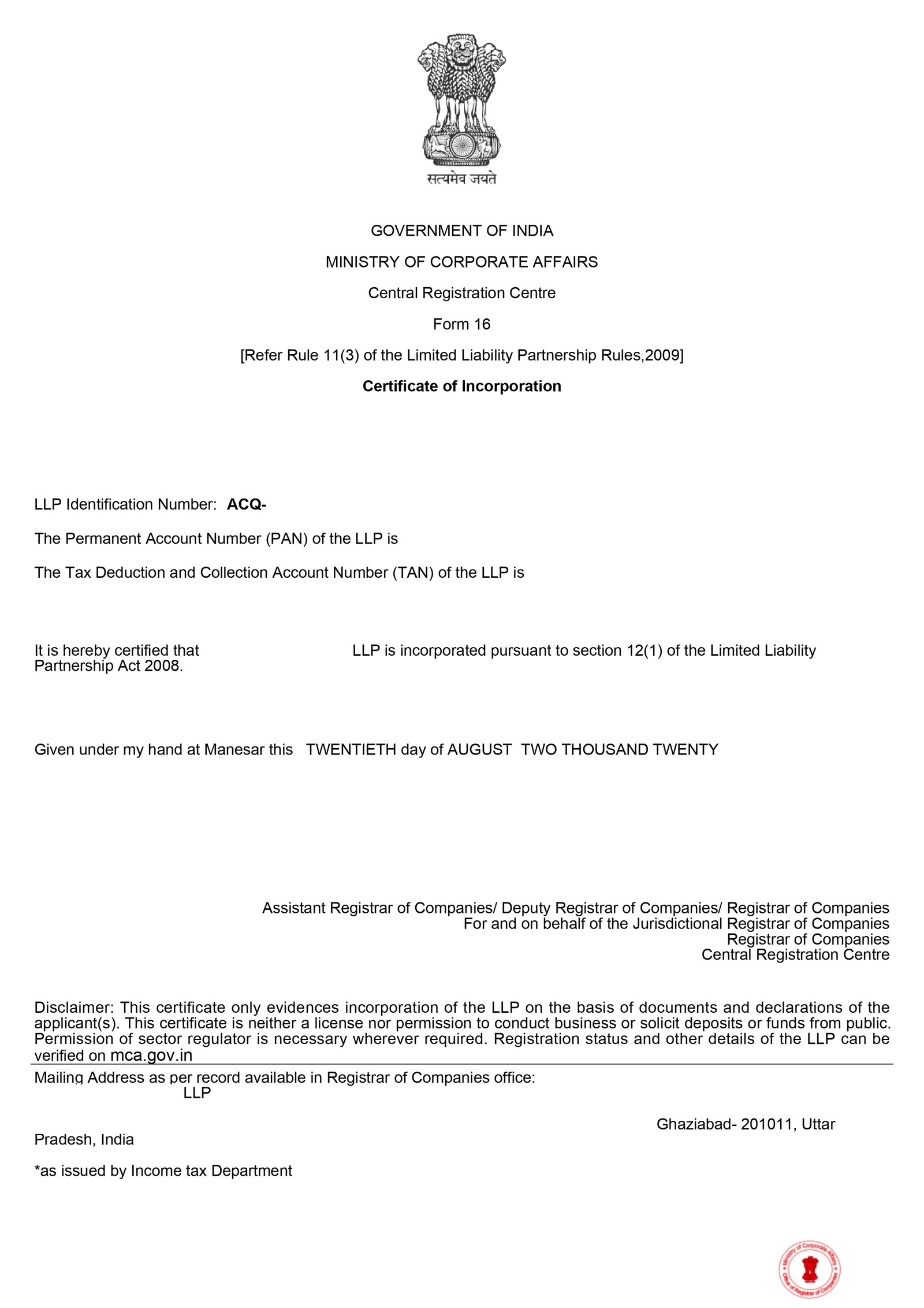
How to Download Your LLP Certificate
- Visit the official Ministry of Corporate Affairs (MCA) portal: mca.gov.in.
- Navigate to 'MCA Services' → 'LLP Services'.
- Select ‘View/Download LLP Incorporation Document.’
- Enter your LLPIN and Date of Incorporation, complete CAPTCHA, and submit to download.
How to Check LLP Registration Status
- Go to the MCA website: mca.gov.in.
- Under 'MCA Services' → 'LLP Services', click on 'Check LLP Name/Status'.
- Enter your proposed LLP name or application number to view the status.
- Alternatively, use 'View Company/LLP Master Data' for details of a registered LLP.
How Much Time Does It Take to Register an LLP?
Registering an LLP usually takes around 10 to 12 working days, depending on how quickly you submit documents, how soon the name is approved, and how efficiently the government processes the application. With professional assistance, the timeline can often be reduced through error-free and streamlined submission. With proper documentation and support for related services such as digital signature certificate, GST registration, and trademark registration, the post-incorporation process also becomes smoother.
Need Help with Your LLP?
Our team is here to guide you through every step. Contact us for expert advice.
Frequently Asked Questions (FAQs)
What is the main advantage of an LLP over a traditional partnership?
The primary advantage is limited liability. In an LLP, partners are not personally liable for the debts of the business, meaning their personal assets are protected. In a traditional partnership, partners have unlimited liability.
Can I convert my existing business into an LLP?
Yes, the LLP Act, 2008 allows for the conversion of an existing partnership firm, a private limited company, or an unlisted public company into an LLP.
Is an audit mandatory for an LLP every year?
An audit is not mandatory for all LLPs. It is only required if the annual turnover exceeds ₹40 lakhs or if the capital contribution exceeds ₹25 lakhs.
What is an LLP Agreement and is it mandatory?
The LLP Agreement is a crucial document that outlines the rights, duties, and profit-sharing ratios of the partners. While you can incorporate an LLP without it, it is mandatory to file the LLP Agreement with the MCA within 30 days of incorporation. If not filed, the provisions of the First Schedule of the LLP Act, 2008 will apply by default.
How many partners are required to register an LLP?
A minimum of 2 partners is required to register an LLP, and at least one partner must be an Indian resident.
How long does LLP registration take in India?
LLP registration usually takes around 7–12 working days, depending on document verification and government approvals.
What documents are required for LLP registration?
Documents generally include PAN Card, Aadhaar Card/Passport, address proof, photographs of partners, and registered office proof.
Is GST registration mandatory for an LLP?
GST registration is mandatory only if the LLP’s turnover exceeds the prescribed limit or if it is engaged in interstate taxable supplies. You can apply for GST registration through Formsy GST Registration Services .
Can a foreign national become a partner in an LLP?
Yes, foreign nationals and NRIs can become partners in an LLP, subject to compliance with FEMA and other applicable regulations.