 Formsy
IEC (Import Export Code) Registration Online in India
Ready to Start Trading Internationally? Formsy makes India’s IEC (Import Export Code) Registration easy and hassle-free, helping you start your international trade journey smoothly.
- IEC Approval in 1-3 Business Days
- Complete Application Filing & Approval
- End-to-End Service Support
- Expert Assistance Throughout
- Trusted by Indian Exporters & Importers
Enter your details to receive a full quote and consultation

What is IEC Registration?
In today’s competitive world, everyone wants to take their business beyond India. Thanks to technology, going global is easier than ever. But before you start importing or exporting, you need to follow certain rules and get specific licenses. One of the most important is the IEC, also called the Importer-Exporter Code, which is required to do any import or export business in India.
The IEC is a must-have for anyone planning to start an import or export business in India. Issued by the DGFT (Directorate General of Foreign Trade), it is a unique 10-digit code that is valid for a lifetime. Without an IEC, importers cannot bring goods into India, and exporters cannot enjoy benefits or schemes offered by the DGFT. Simply put, IEC is your key to start and grow your international trade business. Businesses involved in customs-linked trade may also require ICEGATE registration for smoother import-export processing.
Characteristics of IEC Registration
IEC Registration features several distinctive attributes:
- Permanent Validity: IEC codes have lifetime validity. However, it is mandatory to update your IEC details annually on the DGFT portal between April and June, even if there are no changes. Failure to do so will result in the deactivation of your code.
- Geographical Coverage: Your IEC code is valid throughout India for all ports and customs points for both importing and exporting.
- No Renewal: The IEC does not require any renewal process. Only annual updates are required.
- One-Time Process: Adhering to the IEC registration procedure is a one-time activity for obtaining the code.
- Permitted Activities: Authorizes the import and export of all goods and services allowed under the foreign trade policy.
Objectives of IEC Registration
Government authorities implement the IEC Code Registration to achieve several important goals:
- Regulate import and export activities across borders.
- Maintain records of all foreign trade transactions.
- Generate trade statistics for policy formulation.
- Prevent illegal trading practices and smuggling.
- Ensure compliance with international trade agreements.
- Monitor foreign exchange flow during trade transactions.
- Enables businesses to claim export incentives and benefits under government schemes.
- Helps prevent unlawful trading and smuggling through official registration.
- Allows authorities to monitor and track all import-export transactions.
Different Types of IEC Registration in India
Select the appropriate IEC Registration type based on your specific business structure:

- Sole Proprietorship – Individuals running Sole Proprietorship businesses can apply for the Importer Exporter Code (IEC) to legally engage in import and export activities. This enables sole proprietors to expand internationally and comply with regulatory requirements for foreign trade under Indian law.
- Partnership Firms – Partnership Firms, regardless of their size or sector, are eligible to obtain an IEC registration. This allows partnership setups to participate effectively in global trade and access export-import benefits while ensuring compliance with DGFT regulations.
- Limited Liability Partnership (LLP) – LLPs registered under Indian law can apply for an IEC to conduct import and export transactions. IEC registration for LLPs facilitates international commerce and opens doors to government export promotion schemes and customs clearance benefits.
- Private Limited Companies – Private Limited Companies looking to engage in global trade must obtain an IEC registration. This legal identification is crucial for managing cross-border transactions, accessing export incentives, and fulfilling Customs and DGFT compliance obligations.
- Public Limited Companies – Public limited companies engaged in import or export activities are eligible and required to register for an IEC. The IEC is essential for regulatory compliance, smooth customs clearance, and participation in government export promotion programs.
- Hindu Undivided Family (HUF) – Hindu Undivided Families involved in international trade can apply for IEC registration. This allows HUF entities to conduct import-export operations under a legally recognized trade identity, opening opportunities in global markets.
Why and When You Need an IEC?
An IEC (Import Export Code) is required in several important situations for anyone doing international trade:
- Importing Goods: If you want to bring products into India from other countries, an IEC is mandatory.
- Exporting Products: To sell your goods abroad, you must have an IEC to comply with trade regulations.
- Availing Government Benefits: Exporters can access various schemes, incentives, and subsidies offered by the DGFT only if they have an IEC. Eligible businesses may also combine this with Startup India registration or MSME registration for broader support.
- Customs Clearance: All imported and exported shipments require an IEC for smooth customs processing.
- Opening a Bank Account for Trade: Some banks may ask for an IEC to facilitate foreign transactions and payments.
When is the IEC Code Not Required?
An IEC is not mandatory for all traders registered under GST, as the PAN serves as the IEC for GST-registered businesses. Additionally, the IEC is exempt in the following cases:
- For the import or export of goods for personal use, which are not connected with trade, manufacture, or agriculture.
- By Ministries and Departments of the Central Government or notified State Governments.
- By certain charitable, religious, or educational institutions as notified by the DGFT, for goods imported for non-commercial purposes.
Eligibility Criteria for IEC Registration in India
To qualify for IEC Registration, you must meet these essential requirements:
- Be a resident Indian citizen or a registered business entity
- Maintain an active bank account in India
- Possess a valid PAN card (for individuals and businesses)
- Have a legitimate business address with supporting documentation. Businesses using flexible commercial setups may also rely on a virtual office address where valid and properly documented.
- Demonstrate compliance with business registration requirements
- Provide accurate contact information for verification.
Documents Required for IEC Registration
You need to submit specific documentation to complete your IEC Registration online. The following is a list of documents required:
- IEC Registration Application Form
- PAN Card (mandatory for all applicants)
- Address proof (Aadhaar Card, Voter ID, or utility bills)
- Business registration documents (Partnership Deed, MOA/AOA, Certificate of Incorporation)
- Scanned copy of a bank certificate or a cancelled cheque
- A Passport-sized photograph of the applicant/directors
- Digital Signature Certificate for online submission
Entity-Specific Requirements:
Different business types require additional documentation:
- Proprietorship: Address proof of the proprietor
- Partnership: Partnership deed and partner details
- LLP/Companies: Certificate of incorporation, director details
- Trusts/NGOs: Trust deed and NGO Registration certificate
- Branch Office: Permission letter from the RBI
How to Apply for IEC (Import Export Code):
.png)
- Visit the DGFT Website: Go to the official DGFT Portal.
- Register: Click on ‘Services’ → ‘IEC Profile Management’ → ‘Apply for IEC’ → ‘Register’. Fill in your details and click ‘Send OTP’.
- Verify OTP: Enter the OTP and complete registration. You will get a temporary password, which you can change after logging in.
- Login & Start Application: Log in with your username and password. Click ‘Apply for IEC’ → ‘Start Fresh Application’.
- Fill Details & Upload Documents: Enter business info, personal details, bank info, and attach your Digital Signature Certificate (DSC). Make the payment.
- Download Receipt: After payment, download the receipt for reference.
- Get IEC Certificate: The IEC certificate will be sent to your email. You can also download it from ‘Print IEC’ under IEC Profile Management on the DGFT website.
IEC Registration Fees
Here are the costs related to IEC, so you can make better decisions.
Registration Costs
Plan your budget carefully to account for these costs:
- Basic Application Fee: Government fee is Rs. 500 (non-refundable).
- Digital signature certificate (if required): Rs. 2,000 - Rs. 3,000
- Professional assistance fees (optional): Rs. 2,500 - Rs. 5,000
- IEC modification charges: Rs. 200 per modification request.
Validity of IEC Code
An IEC number is valid for the lifetime of the entity. There is no need for renewal. However, as per a recent mandate, all IEC holders must update their details electronically every year between April and June on the DGFT portal. If an IEC is not updated within the prescribed time, it will be deactivated.
If a business stops its import or export operations, it may choose to surrender its IEC. The surrender process involves notifying the DGFT about the discontinuation of trade activities. This allows the DGFT to update its records and deactivate the IEC accordingly.
Comprehensive Benefits of IEC Registration
Import Export Code (IEC) registration offers multiple benefits for businesses looking to enter international markets. It is a mandatory registration for import-export businesses in India and helps companies expand globally with ease. Here are some major advantages of obtaining an IEC certificate:
- Global Market Access: IEC registration allows businesses to legally import and export goods and services across international borders, helping companies expand their business globally.
- Simple Online Registration Process: The IEC registration process is completely online through the DGFT portal, making it quick, paperless, and hassle-free.
- Lifetime Validity: Once issued, the IEC certificate remains valid for a lifetime and does not require renewal.
- Easy Foreign Payment Transactions: Businesses can receive international payments smoothly through banks using their Import Export Code.
- Access to Government Export Benefits: IEC holders can avail various export incentives, subsidies, and schemes offered by DGFT, Customs authorities, and Export Promotion Councils.
- Improves Business Credibility: Having an IEC code increases trust among foreign buyers, suppliers, logistics companies, and financial institutions.
- No Mandatory Annual Return Filing: Unlike many other registrations, IEC registration does not involve heavy recurring compliance requirements.
Disadvantages of IEC Registration
Although IEC registration provides significant benefits for import-export businesses, there are certain challenges and responsibilities associated with international trade activities. Some disadvantages include:
- Mandatory Compliance for Import-Export Activities: Businesses involved in international trade must comply with customs regulations, DGFT rules, and foreign trade policies.
- Annual IEC Update Requirement: IEC holders are required to update or confirm their IEC details annually on the DGFT portal to maintain active status.
- Additional Licenses May Be Required: Certain products require special approvals, export licenses, or certifications from government authorities before import or export.
- International Trade Risks: Businesses may face issues such as customs delays, shipment losses, currency fluctuations, and changing international trade regulations.
- GST and Tax Compliance: Import-export businesses may also need GST registration and regular tax compliance depending on their turnover and business activities.
Post Compliance Requirements for IEC
After obtaining an IEC certificate, businesses must ensure proper compliance with DGFT regulations and international trade requirements. Maintaining compliance helps businesses avoid penalties and ensures smooth import-export operations. Important post-registration compliances for IEC registration include:
- Annual IEC Confirmation or Update: Every IEC holder must confirm or update their IEC details annually on the DGFT portal between April and June.
- Maintain Updated Business Information: Businesses should update changes related to address, bank account details, email ID, or ownership information whenever required.
- GST Compliance: Businesses involved in taxable supplies must file GST returns and comply with GST regulations applicable to import-export activities.
- Customs Documentation Compliance: Importers and exporters must maintain proper shipping bills, invoices, customs documents, and foreign transaction records.
- Compliance with Foreign Trade Policy: Businesses must ensure that imported and exported goods comply with DGFT guidelines and India’s Foreign Trade Policy.
- Proper Financial Record Maintenance: IEC holders should maintain records of international transactions, export-import invoices, customs clearances, and foreign remittances for accounting and taxation purposes.
Grounds for IEC Suspension in India
Several factors can lead to the suspension of your IEC Registration:
- Compliance Failures: Failing to update business information when required.
- Documentation Issues: Providing false or misleading information during registration.
- Regulatory Violations: Breaking foreign trade policy rules or customs regulations.
- Security Concerns: Trading in restricted or prohibited items without proper licenses.
- Financial Irregularities: Engaging in foreign exchange violations or money laundering.
IEC Registration Certificate
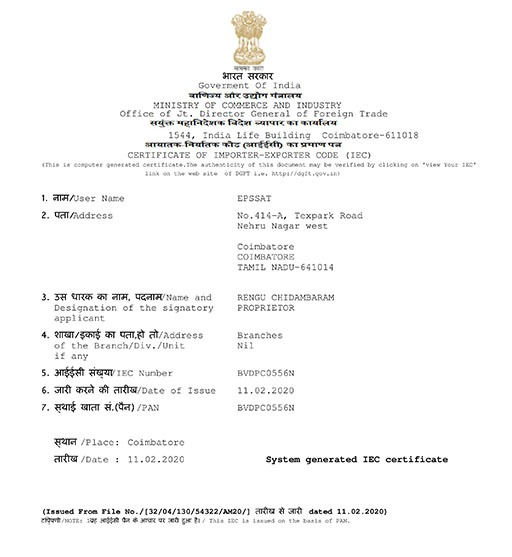
After your Import Export Code (IEC) registration is successfully approved by the Directorate General of Foreign Trade (DGFT), you’ll receive an IEC Certificate. This official document confirms that your business is authorized to carry out import and export activities in India. The IEC certificate contains important details such as your business name, IEC number, PAN details, and date of issue. It serves as a key identification document for international trade activities. You’ll need the IEC certificate for several business operations, such as:
- Importing goods into India
- Exporting products or services to international markets
- Customs clearance at ports and airports
- Receiving foreign currency payments in your bank account
- Registering on international marketplaces and trade platforms
- Applying for export incentives and government schemes
Having a valid IEC certificate enhances your business credibility with customs authorities, banks, logistics partners, and overseas clients while ensuring smooth cross-border trade operations.
How to Download the IEC Code Certificate?
Here are the steps to download the IEC certificate:
- Login to DGFT portal: Access the DGFT website and log in with your credentials.
- Navigate to the IEC section: Go to the 'Services' section and select 'IEC Profile Management'.
- View IEC: Click on 'View IEC' to see the details of your IEC code.
- Download certificate: Find the option to 'Download IEC Certificate' and click on it.
- Save the file: The certificate will be downloaded in PDF format; save it to your device.
- Print certificate: You can print the certificate if a hard copy is required.
How to Check IEC Registration Status?
To check whether your Import Export Code (IEC) is registered and active in India, follow these simple steps:
- Visit the DGFT website: Go to the DGFT portal at www.dgft.gov.in.
- Access IEC Profile Management: Navigate to the “Services” section and select “IEC Profile Management” or use the IEC search option available on the portal.
- Enter your IEC details: Type in your IEC number, PAN number, or business name as required.
- Complete the CAPTCHA and submit: Enter the verification code and click on “Search” or “Submit.”
- Check the status: You’ll be able to view important details such as IEC number status, business name, date of issue, and registered business information.
- If you face any issues: You can contact the DGFT helpdesk or visit the nearest DGFT regional office for assistance.
If you face any issues while checking your IEC status, you can contact the DGFT helpdesk or visit the nearest DGFT regional office for assistance.
Go Global with Formsy!
Get your IEC Registration done right. Our experts ensure a smooth and compliant process from start to finish.
Frequently Asked Questions (FAQs)
Is it mandatory to update the IEC every year?
Yes, as per the latest regulations, it is mandatory to electronically update and verify your IEC details on the DGFT portal every year between April and June, even if there are no changes. Failure to do so may result in the deactivation of your IEC.
Can I have multiple IECs for different businesses?
No, only one IEC is issued against a single PAN card. If you have multiple businesses under different entities (with different PANs), each entity can have its own IEC.
Do I need an IEC for importing or exporting services?
Yes, IEC is mandatory for the export of services to avail benefits under the Foreign Trade Policy. For import of services, IEC is required in most cases, especially when dealing with foreign currency transactions through banks.
How long does it take to get an IEC certificate?
IEC registration is usually processed within 1–3 working days after successful document verification by DGFT.
Can an individual apply for an IEC code?
Yes, proprietors, freelancers, startups, and individual exporters/importers can apply for an IEC using their PAN card.
Is GST mandatory for obtaining IEC registration?
No, GST is not mandatory in every case. However, businesses involved in taxable supplies may require GST registration as per applicable laws.
What documents are required for IEC registration?
Generally, PAN card, Aadhaar card, business address proof, bank details, and a canceled cheque are required for IEC registration.
Can I modify my IEC details after registration?
Yes, details such as address, phone number, email ID, and business information can be updated through the DGFT portal.