 Formsy
NGO Registration Online in India
Register your NGO in India for legal recognition, funding eligibility, and tax exemption. Build credibility and run your NGO seamlessly with expert assistance. Get professional help for a hassle-free, compliant NGO registration process.
- Draft Trust Deed or Memorandum of Association (MOA) and Articles of Association (AOA)
- File registration documents with relevant authorities for Trust, Society, or Section 8 Company
- Assistance with 12A and 80G tax exemption registration
- Get expert help for legal and compliance procedures
- Seamless registration support at affordable pricing
Enter your details to receive a full quote and consultation

What is NGO Registration?
NGO Registration is the formal legal process of establishing a Non-Governmental Organization in India to operate as a nonprofit entity focused on charitable, social, educational, or cultural objectives. Registering an NGO gives it a legal identity under Indian law, enabling official operations, opening bank accounts, applying for funding, and entering contracts.
An NGO can be registered as:
- A Trust under the Indian Trusts Act,
- A Society under the Societies Registration Act,
- Or a Section 8 Company under the Companies Act 2013.
NGO registration enhances credibility, ensures compliance with government regulations, and makes the NGO eligible for various tax benefits under Sections 12A and 80G of the Income Tax Act. It also facilitates access to domestic and international funding, including corporate social responsibility (CSR) contributions and formal registrations that improve institutional credibility, such as MSME registration, while promoting transparency and public trust.
This registration process involves drafting necessary constitutional documents (Trust Deed or Memorandum and Articles of Association), submitting required documents to the relevant authority based on NGO type, and obtaining a registration certificate confirming legal status.
Benefits of NGO Registration
Registering your NGO in India offers significant advantages including legal recognition, access to government schemes, tax exemptions, and expanded funding opportunities. An officially registered NGO gains legal status, allowing it to operate transparently, enter contracts, and open bank accounts. It enhances your organization's credibility among donors, stakeholders, and the public, promoting greater trust and support.
- Legal Identity & Compliance: Grants your NGO its own legal entity status under Indian law, ensuring adherence to regulations and eligibility for official funding. NGOs running structured projects may also benefit from formal branding and identity protection through trademark registration.
- Tax Benefits: Registered NGOs can avail income tax exemptions under Section 12A and provide donors with tax deductions under Section 80G, encouraging donor generosity.
- Access to Funds & Grants: Enables receipt of government grants, CSR funding, and domestic/international donations, especially after acquiring the FCRA registration for foreign contributions.
- Operational Transparency: Boosts public confidence through mandatory compliance and reporting, establishing accountability in operations.
- Banking & Financial Operations: Registration allows opening official bank accounts, simplifying fundraising and financial management. Proper financial management also supports smoother income tax return filing and audit readiness.
- Strategic Partnerships: Facilitates collaborations with government agencies, corporates, and other NGOs to amplify social impact.
- Perpetual Succession: Ensures the NGO’s continuous existence despite changes in leadership, securing long-term mission sustainability.
Key Objectives of Registering a NGO
The objective of NGO registration is to establish a formal legal entity that can pursue nonprofit activities with proper governance and accountability.
- Legal Recognition: Obtain official status as a legitimate organization operating within the legal framework.
- Separate Legal Entity: Create a distinct entity separate from its founders, with perpetual succession.
- Fundraising Capability: Enable the organization to legally receive donations, grants, and funding from various sources.
- Tax Benefits: Qualify for income tax exemptions under sections 12A and 80G of the Income Tax Act. NGOs must still maintain timely income tax return filing and supporting documentation for ongoing compliance.
- Operational Framework: Establish governance structures with defined roles, responsibilities, and decision-making processes.
- Credibility Enhancement: Build trust with donors, beneficiaries, and the general public through formal registration.
- Resource Mobilization: Access institutional funding from government agencies, corporate CSR programs, and international donors.
- Regulatory Compliance: Fulfill statutory obligations and maintain transparency in operations and financial management.
Types of NGOs in India
NGO registration in India can be accomplished through several legal structures, each with its own characteristics and benefits:
-
Trust Registration
For organizations managing assets under a trust deed, trust registration is crucial to gain legal recognition, comply with regulations, and avail tax benefits.
Example: A philanthropist sets up a trust to fund healthcare facilities in rural districts to honor a family legacy. -
Society Registration
When seven or more individuals unite to promote education, health, or social welfare, society registration provides a legal and formal structure.
Example: A group of artists forms a society dedicated to preserving traditional arts and providing skill training to youth. -
Section 8 Company
This is for nonprofits incorporated as companies focused on social innovation, education, or environmental protection, with profits reinvested into objectives, and it follows a more formal company-style framework similar to company registration.
Example: A coalition of environmental activists registering a Section 8 company to run sustainable urban farming programs. -
Religious Endowments
Entities managing temples, mosques, gurudwaras, or other religious institutions register for proper management of religious assets and charitable activities.
Example: A community establishes a trust to oversee the renovation, festivals, and charity work of a historic temple. -
Waqf Registration
For permanent dedication of property under Islamic law for charitable or religious causes, Waqf registration ensures compliant administration and use of assets.
Example: A philanthropist creates a Waqf to support madrassas and community welfare projects in an urban area.
Eligibility Criteria for NGO Registration
Eligibility for NGO registration varies based on the chosen legal structure, but generally includes these fundamental requirements.
-
Minimum Number of Founding Members
- Trusts require at least 2 trustees to start.
- Societies need a minimum of 7 members to register.
- Section 8 Companies mandate at least 2 directors and 2 shareholders.
-
Age and Legal Capacity
All founding members must be adults (18+ years), mentally sound, and legally competent to enter into binding agreements.
-
Charitable and Social Objectives
The NGO must have clearly defined charitable, educational, religious, cultural, scientific, environmental, or social welfare goals aligned with nonprofit purposes.
-
Non-Profit Nature
The organization must not distribute profits or dividends among members. All revenue should be reinvested to further the NGO’s objectives. Registration also enables benefits like MSME registration to access government schemes.
-
Governing Documents
A legally drafted Trust Deed, Memorandum of Association (MOA), or Articles of Association (AOA) detailing the objectives, rules, and structure is essential for registration.
-
Indian Residency Requirement (FCRA Compliance)
For FCRA registration (foreign funding eligibility), at least 51% of the governing body should be Indian citizens to ensure compliance with foreign contribution regulations.
-
Clean Criminal Record
Founders and key members must not have convictions involving moral turpitude, financial fraud, or terrorism to ensure integrity and public trust.
-
Commitment to Regulatory Compliance
NGOs must maintain proper financial records, file timely annual returns, undergo audits, and adhere strictly to all statutory requirements mandated by law.
Meeting these criteria is essential for smooth NGO registration and continued compliance with Indian regulatory frameworks.
Documents Required for NGO Registration
Proper documentation is crucial for smooth NGO registration, with requirements varying by registration type:
1. Identification Documents
- PAN cards of all the founding members
- Aadhaar cards of all the founding members
- Address proof of all founding members (utility bills, rental agreements, etc.)
2. Organizational Documents
- For Trust: Trust deed on stamp paper
- For Society: Memorandum of Association and Rules & Regulations
- For Section 8 Company: Memorandum of Association and Articles of Association
3. Property Documents
- Proof of registered office address (rent agreement, NOC from the owner). Organizations without a permanent premises may explore a compliant virtual office address, where accepted for the chosen registration structure.
- Utility bills for the office premises
- Property documents: if the NGO owns property
4. Financial Documents
- Bank account details
- Initial fund proof for the organization
- Affidavit of funding sources
5. Meeting Records
- Minutes of the preliminary meeting
- Resolution for the formation of the organization
- Election records of governing body members
6. Activity Plan Documents
- Detailed project proposal outlining planned activities
- Operational budget for the first year
- Implementation strategy for charitable objectives
7. Additional Requirements
- Photographs of all founding members
- Character certificates (for some states)
- No Objection Certificate from concerned departments (if required)
How to Register a NGO in India?
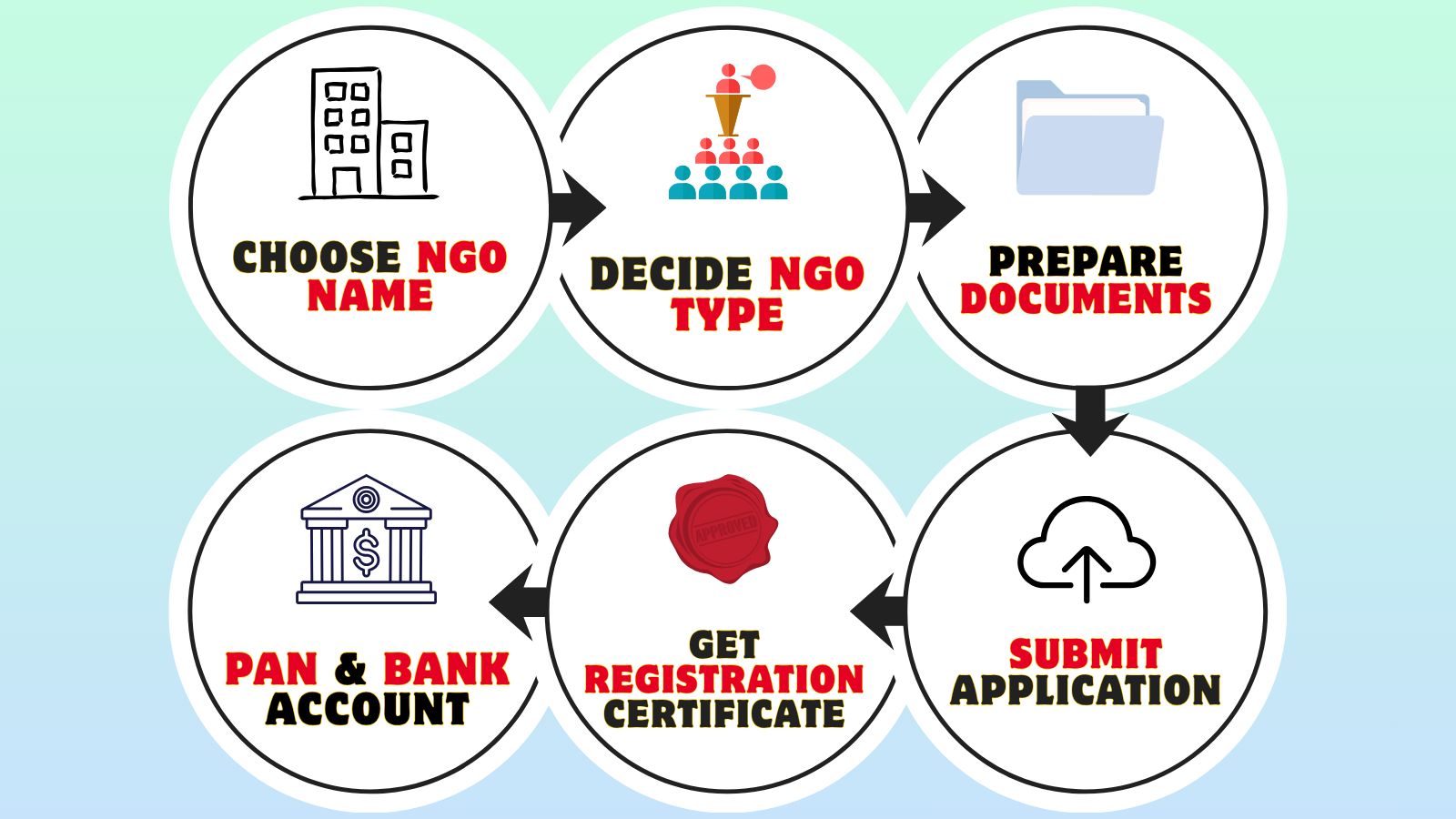
Understanding how to register an NGO in India involves several key steps, which may vary slightly depending on the chosen legal structure.
-
Step 1: Choose the Right Name for Your NGO
Select a unique and meaningful name that reflects your NGO’s objectives. The name should not conflict with existing organizations or violate any trademarks.
-
Step 2: Decide the Type of NGO to Register
Choose whether you want to register your NGO as a Trust, Society, or Section 8 Company based on your goals, members, and operational scale. Refer to the table below for differences and suitability.
-
Step 3: Prepare Required Documents
Depending on the NGO type, gather necessary documents such as:
- Trust Deed for Trusts
- Memorandum of Association (MoA) and Rules for Societies
- MoA and Articles of Association (AoA) for Section 8 Companies
- Along with ID proofs, address proofs, and affidavits of members or trustees.
-
Step 4: Submit Application and Registration Fee
Apply to the relevant authority:
- Sub-Registrar for Trust Registration
- Registrar of Societies for Society Registration
- Ministry of Corporate Affairs (MCA) for a Section 8 Company
Pay the applicable government registration fees.
-
Step 5: Obtain Certificate of Registration
Once approved, you will receive the official registration certificate:
- Trust Deed Registration Certificate
- Society Registration Certificate
- Certificate of Incorporation for Section 8 Company
-
Step 6: Apply for PAN and Open a Bank Account
Apply for a PAN card in the NGO’s name and open a bank account to manage finances.
Comparison Between Trust, Society & Section 8 Company
| Basis | Trust | Society | Section 8 Company |
|---|---|---|---|
| Applicable Law | Indian Trusts Act, 1882 State-specific Trust Acts Registration Act, 1908 |
Societies Registration Act, 1860 |
Companies Act, 2013 (Section 8) |
| Legal Status | Separate legal entity Can sue or be sued |
Separate legal entity Can sue or be sued |
Separate legal entity with limited liability |
| Objective | Charitable, religious, public purposes |
Literary, scientific, charitable, social welfare |
Promotion of commerce, arts, science, charity, education, environment |
| Minimum Members | Minimum 2 trustees | Minimum 7 members | Minimum 2 directors and 2 shareholders |
| Governance Documents |
Trust Deed | Memorandum of Association (MoA) Rules & Regulations |
Memorandum of Association (MoA) Articles of Association (AoA) |
| Registration Authority |
Sub-Registrar or Charity Commissioner (state-wise) |
Registrar of Societies | Registrar of Companies (ROC) |
| Profit Distribution | No profit distribution; benefits for beneficiaries only |
No profit distribution; funds utilized for objectives |
No dividend distribution; profits reinvested in objectives |
| Tax Benefits | Eligible for 12A & 80G registrations |
Eligible for 12A & 80G registrations |
Eligible for 12A & 80G registrations |
| Compliance Requirements |
Moderate Annual filing varies by state |
Moderate Annual filing of returns and audit |
Higher Annual filing of financials with MCA, audits, board meetings |
| Best Suited For | Family trusts, religious trusts, charitable trusts focusing on specific communities |
Social clubs, educational institutions, service organizations, NGOs with multiple members |
Large scale NGOs, foundations, and charitable companies with wider operations and corporate governance needs |
| Example | A family trust for healthcare services |
A society providing rural education |
An NGO promoting environmental sustainability under Section 8 |
Note: NGOs considering a company-governed nonprofit model often compare it with other formal structures such as private limited company registration to understand differences in compliance, governance, and legal treatment.
Post Compliance Requirements for a NGO
Adhering to these post-registration compliance norms is critical for NGOs to maintain legal validity, build donor confidence, unlock funding opportunities, and ensure sustainable operations in India.
- Conduct Regular Board Meetings: Hold at least two board meetings annually; maintain detailed minutes to document decisions and approvals.
- File Annual Returns: Submit annual activity and financial reports to the Registrar of Societies, Registrar of Companies, or relevant authority to maintain legal status and transparency.
- Maintain Proper Books of Accounts: Keep accurate accounting records in prescribed formats, documenting all financial transactions, donations, and expenses.
- Annual Tax Filings: File income tax returns (Form ITR-7) yearly, irrespective of income, and submit audit reports as required under Sections 12A and 80G.
- Audit of Accounts: Get audited accounts conducted by a qualified Chartered Accountant to ensure accuracy and compliance with statutory regulations.
- Renewal of Registrations: Renew mandatory registrations like FCRA (if receiving foreign funds), 12A, and 80G per the prescribed timelines to retain benefits.
- Maintain Transparency and Compliance with FCRA Rules: For NGOs receiving foreign contributions, adhere strictly to FCRA guidelines including maintaining separate bank accounts, filing Form FC-4 annually, and timely reporting of foreign funds.
- Opening and Operating Bank Accounts: Operate dedicated NGO bank accounts for collection and utilisation of funds; ensure reconciliation and transparency in bank transactions.
- Organize Annual General Meetings (AGMs): Host AGMs as per statutory requirements to discuss and approve financial statements, future projects, and compliance reports.
- Report CSR Fund Utilization: For NGOs receiving CSR funds, submit necessary reports to donors and government bodies showcasing fund utilization and project impact.
Tax Exemptions and Registrations for NGO
These tax registrations and exemptions collectively support NGOs in maximizing their funds, attracting donors, maintaining compliance, and advancing their social missions effectively in India.
-
Section 12A Registration
- Grants the NGO exemption from paying income tax on donations and surplus income used for charitable purposes.
- Registration must be renewed every 5 years as per the updated Income Tax rules since April 2021.
- Essential for NGOs to legally save more funds for their social causes by reducing tax liabilities.
-
Section 80G Registration
- Enables donors to claim a deduction of 50% (or as specified) on donations made to the NGO, providing a tax benefit to contributors.
- This certification encourages philanthropy by making donations more attractive to individuals and corporate donors.
- Renewed periodically (usually every 5 years) to ensure compliance and continuous donor confidence.
-
Foreign Contribution Regulation Act (FCRA) Registration
- Mandatory for NGOs to receive donations from foreign sources legally.
- Ensures transparency and accountability in the receipt and utilization of foreign funds.
- Regular reporting and compliance with FCRA rules is required for continued eligibility.
-
Goods and Services Tax (GST) Registration
- Required if the NGO’s annual turnover exceeds the prescribed threshold limit or if it engages in taxable services, in which case GST registration becomes necessary.
- Enables input tax credit and compliance with indirect tax laws.
-
Other Tax Benefits
Certain NGOs may also qualify for local state-level rebates and exemptions based on specific laws that provide further financial relief.
-
Compliance and Documentation
NGOs must maintain audited financial statements, file annual income tax returns (Form ITR-7), and submit necessary forms for 12A and 80G registrations (e.g., Form 10A and Form 10AB for renewals). Adherence to new guidelines ensures these certifications remain valid and the NGO stays eligible for tax benefits.
NGO Registration Certificate
An NGO Registration Certificate is an official document issued by the government that legally recognizes your organization as a registered nonprofit entity. This certificate is proof of your NGO’s existence and allows you to operate, receive funding, and enjoy various legal benefits. It is essential for building credibility and gaining trust among donors, partners, and beneficiaries.
The certificate contains important details such as the NGO’s name, registration number, date of registration, and registered address. Once your NGO is successfully registered, you can download this certificate online from the respective government portal where your NGO was registered.

How to Download an NGO Registration Certificate Online?
To download the certificate:
- Visit the official registration portal of your state or the Ministry of Corporate Affairs (for Section 8 companies).
- Navigate to the “View Registered NGO” or “Download Certificate” section.
- Enter required details such as your NGO’s registration number, date of registration, and name.
- Complete any CAPTCHA or verification process.
- Submit the form and download the certificate in PDF format.
How to Check NGO Registration Status Online?
To check status online:
- Go to the official NGO registration portal used for your registration.
- Look for the “Check Registration Status” or “Track Application” option.
- Enter the application number or registration details as required.
- Submit the information to view the current status of your registration.
- If needed, contact the registrar’s office for further assistance.
Fundraising Options and Support for NGOs
NGOs (Non-Governmental Organizations) rely heavily on diverse fundraising options and robust support to fulfill their missions and achieve sustainable impact.
Fundraising Options for NGOs in India
NGOs leverage diverse fundraising strategies to sustain financial health and maximize social impact. Employing multiple funding channels ensures resilience and steady cash flow.
-
Grants
- Government Grants: Central, state, and foreign governments offer targeted grants for NGOs working in education, health, rural upliftment, and environmental conservation. Portals like NGO-DARPAN facilitate access to such schemes.
- Corporate Grants (CSR): Under the Companies Act, Indian firms allocate a portion of profits for CSR, funding NGOs aligned with their values. NGOs presenting a strong legal and compliance profile, including proper filings and identity protection through trademark registration, may improve donor confidence.
- Foundation Grants: International philanthropic foundations (e.g., Ford Foundation, Gates Foundation) provide project-specific or capacity-building funds.
- International Organization Funds: Agencies such as UNICEF and WHO award grants for work on global causes.
-
Individual Donations and Philanthropy
- Online Donations: Optimized websites with secure payment gateways and compelling stories help attract individual donors. Crowdfunding platforms such as Ketto and Milaap broaden reach. A clearly established legal identity, like a registered NGO or formal company-style structure, increases trust similar to other registered entities such as private limited companies.
- Email and Direct Mail Campaigns: Personalized communication fosters donor engagement and support.
- Recurring Donations: Monthly giving programs build sustained financial support.
- Major Gifts and Legacy Giving: Cultivation of large donors and inclusion in wills secures long-term funding.
-
Events and Campaigns
- Fundraising Events: Charity walks, galas, auctions, and virtual events raise funds and awareness.
- Peer-to-Peer Fundraising: Supporters raise funds by mobilizing their networks.
- Merchandise Sales: Selling branded goods promotes the NGO while raising money.
- Awareness Campaigns: While indirect, greater visibility often converts into donations.
-
Income-Generating Activities and Social Enterprises
NGOs develop mission-aligned businesses like handicraft sales or training programs to create self-sustaining revenue sources.
-
Corporate Partnerships
Beyond grants, partnerships include sponsorships, matching gift programs, pro bono services, and joint initiatives.
-
Loans and Financial Support
NGOs may opt for short-term loans or credit facilities to manage cash flow or seize opportunities when funds are delayed.
Fundraising Support for NGOs
- Capacity Building: Training in grant writing, digital marketing, donor management, and event planning strengthens fundraising capabilities. Tools for organizational assessment and CRM adoption streamline donor relations.
- Mentorship and Networking: Access to expert mentors, peer groups, and NGO associations promotes best practice sharing and strategic partnerships.
- Online Resources: Grant databases, crowdfunding platforms, and government portals simplify fund sourcing and application processes.
- Legal and Regulatory Assistance: Guidance on tax exemption registrations (12A, 80G), FCRA compliance, and donor incentives ensures fundraising legitimacy.
- Communication and Marketing: Support in digital presence building, impact storytelling, branding, and donor engagement materials enhances fundraising reach.
Need Help with NGO Registration?
Let our experts handle the entire registration process for you. Get started today!
Frequently Asked Questions (FAQs)
What is an NGO?
An NGO (Non-Governmental Organization) is a nonprofit group that works independently from the government to address social, cultural, or environmental issues.
Why should I register an NGO in India?
Registration provides legal recognition, access to government and private funding, tax exemptions, and builds credibility with donors and beneficiaries.
What are the types of NGOs in India?
NGOs can be registered as Trusts (Indian Trusts Act), Societies (Societies Registration Act), or Section 8 Companies (Companies Act 2013).
What is the eligibility criteria for registering an NGO?
Eligibility varies by NGO type but generally requires a minimum number of members, a registered office, and clear social objectives.
What documents are needed for NGO registration?
Key documents include identity/address proofs of members, Trust Deed or MOA/AOA, photographs, proof of registered office, and affidavits if required.
How long does NGO registration take?
Depending on the type and completeness of documents, registration may take from 15 days to several months.
Can foreigners or NRIs start an NGO in India?
Yes, with prior permission from the Foreign Contribution Regulation Act (FCRA) authorities to receive foreign funds.
What are the post-registration compliance requirements?
Filing annual returns, maintaining accounts, conducting meetings, and applying for PAN/12A/80G registrations.
How does 12A and 80G registration benefit NGOs?
12A offers income tax exemption for the NGO, while 80G enables donors to claim tax deductions on their donations.
What kind of support can I get for NGO registration?
Expert assistance with legal documentation, filing applications, tax registrations, and ongoing compliance management.