 Formsy
Copyright Registration Online in India
Ready to Protect Your Original Work? Formsy simplifies the entire Copyright Registration process with expert assistance, quick documentation support, and hassle-free online filing from start to finish.
- Hassle-Free Online Filing Support
- Expert Assistance from Registered IPs
- Accurate Copyright Documentation & Filing Process
- Complete Compliance with the Copyright Act, 1957
Enter your details to receive a full quote and consultation

What is Copyright Registration?
Copyright Registration is the official legal process of securing your ownership over an original creative work with the government. This registration grants you exclusive rights over how your work is used, distributed, and reproduced.
At its simplest, copyright means the “right to copy.” It is a legal right granted to creators of original literary works, artistic creations, musical compositions, films, sound recordings, software, and other intellectual property.
Copyright registration in India is governed by the Copyright Act, 1957. Although copyright protection arises automatically upon creation of a work, registration provides strong legal evidence of ownership and significantly improves enforcement rights in disputes and infringement matters.
Purpose of Copyright Registration
The main purpose of Copyright Registration is:
- Get Official Proof: Creates public legal evidence of ownership and authorship.
- Protect Your Work: Helps creators take legal action against unauthorized copying and piracy.
- Simplify Monetization: Makes licensing, assignment, royalty collection, and commercialization easier.
- Gain Full Control: Gives creators exclusive control over reproduction, adaptation, and distribution rights.
The Copyright Symbol
The official copyright symbol is ©. Under the Copyright Act, 1957, the use of the © symbol informs the public that a work is protected under copyright law.
- Usage: It is usually followed by the Year of First Publication and the Name of the Owner (Example: © 2024 Your Company Name).
- Legal Importance: While using the symbol is not a mandatory legal requirement for protection in India, it is highly recommended as it prevents infringers from claiming they were "unaware" of your ownership.
Key Features of Copyright Registration in India
Copyright registration provides legal recognition, commercial protection, and enforcement rights for creators, businesses, artists, startups, filmmakers, software developers, and musicians.
- Legal Recognition & Evidence: Registration acts as prima facie legal proof of ownership in courts and helps establish priority during disputes.
- Voluntary but Strategic: Copyright protection exists automatically, but registration strengthens legal enforceability and commercial credibility.
- Wide Coverage of Creative Works: Copyright law in India recognizes a wide range of creative works, ensuring that creators across different fields can safeguard their intellectual property. Copyright law protects literary works, music, films, software, logos, artistic works, sound recordings, and databases.
- Commercial & Licensing Benefits: Simplifies royalty collection, licensing agreements, assignments, and monetization opportunities along with facilitating international recognition under WIPO treaties. It strengthens the position of startups, freelancers, and businesses in protecting branding and creative assets.
- Digital & Modern Protection: The 2012 amendment introduced safeguards for the digital environment. Copyright law also protects digital content, online works, streaming media, and software applications.
Laws Governing Copyright Registration in India
Copyright registration in India is governed primarily by the Copyright Act, 1957 and the Copyright Rules, 2013. These laws regulate ownership, registration, licensing, assignment, enforcement, and protection of creative works in India.
The Copyright Office under the Department for Promotion of Industry and Internal Trade (DPIIT) manages the copyright registration system and maintains the Register of Copyrights.
The legal foundation for registration is found in Chapter X (Sections 44 to 50A) of the Copyright Act. Important legal provisions include:
- Section 44: Mandates the Copyright Office to maintain a register containing the names of works, authors, and owners.
- Section 45: Allows authors, publishers, or interested persons to apply for registration by filing Form XIV along with the prescribed fee.
- Section 48: States that the Register of Copyrights is prima facie evidence in any court of law, meaning the details in the certificate are presumed true unless proven otherwise
- Section 50: Rectification and cancellation of copyright entries.
Types of Creative Works Protected Under Copyright Registration
Indian copyright law protects a wide range of original creative and intellectual works created by individuals, professionals, startups, companies, and artists.
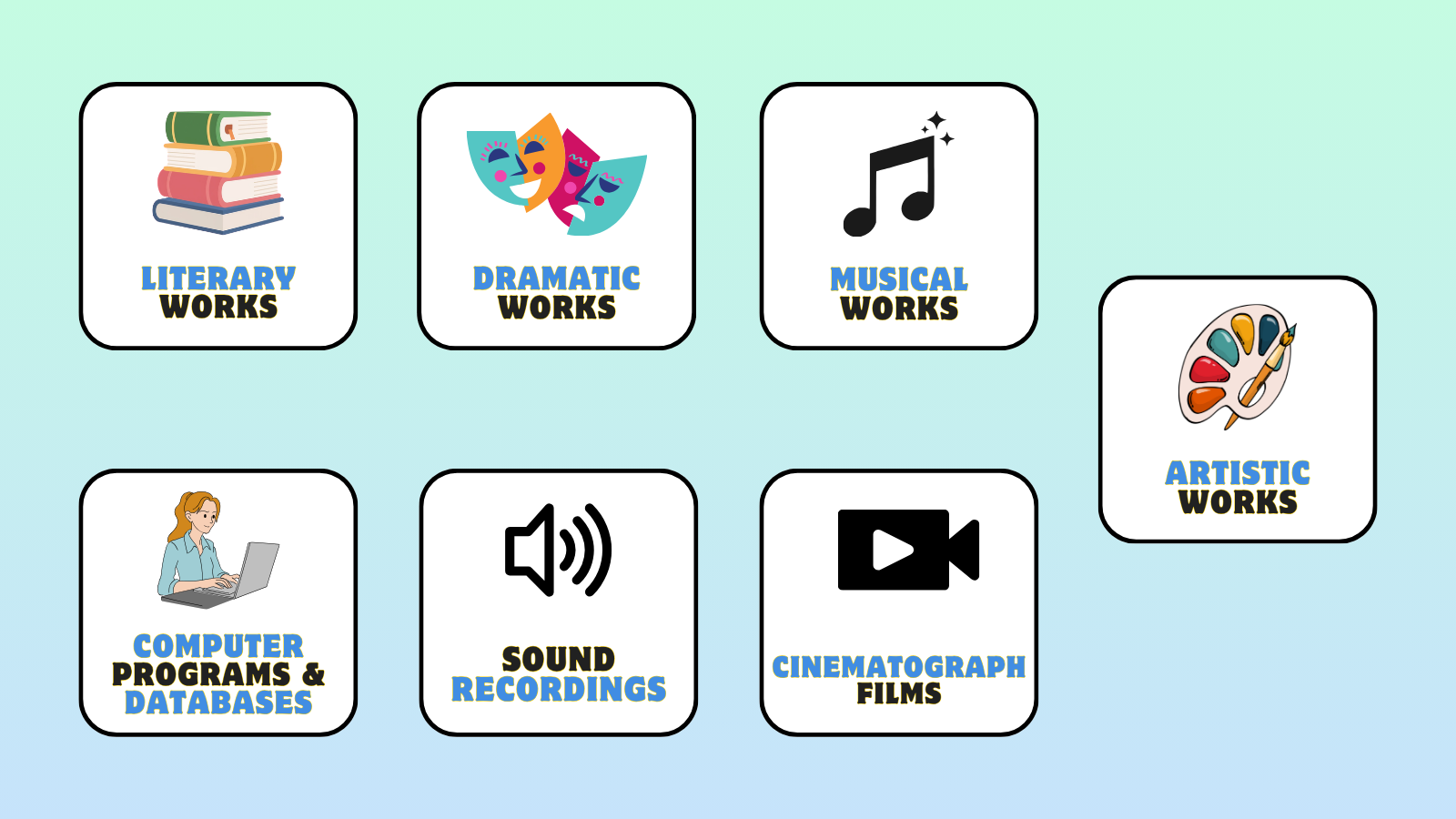
- Literary Works: Books, articles, blogs, scripts, research papers, and software code.
- Dramatic Works: Plays, choreography, dialogues, and performance scripts.
- Musical Works: Song compositions, lyrics, melodies, and scores.
- Artistic Works: Paintings, drawings, logos, illustrations, photographs, and architectural designs.
- Cinematograph Films: Movies, short films, YouTube videos, documentaries, and advertisements.
- Sound Recordings: Songs, podcasts, speeches, audiobooks, and recorded performances.
- Computer Programs & Databases: Software applications, source code, databases, and mobile apps.
Why is Copyright Registration Required?
Copyright registration is important because it strengthens ownership rights, improves legal enforceability, and enhances the commercial value of intellectual property assets.
- Legal Strength & Ownership Proof: Registration creates official legal evidence of ownership and helps resolve disputes efficiently.
- Commercial Leverage: Simplifies licensing, royalty collection, partnerships, and investor confidence.
- Global Recognition: Registered works benefit from international protection under WIPO treaties and conventions.
- Digital Protection: Copyright law protects online content, digital products, apps, software, and streaming media.
- Strategic Advantage: Registration deters infringement and improves professional and commercial credibility.
Eligibility Criteria for Copyright Registration
To qualify for copyright registration in India, the work must satisfy the eligibility requirements under the Copyright Act, 1957.
- The work must be original and independently created.
- The work must be fixed in a tangible medium such as written, recorded, coded, or designed format.
- The work should fall under categories protected by copyright law.
- The work should not merely consist of ideas, concepts, systems, or methods.
- The work must not belong to the public domain.
Eligible applicants include:
- The original author or creator of the work.
- The owner or employer if the work was created during employment.
- A commissioning party for commissioned works such as films or photographs.
- An authorized representative with a valid Power of Attorney.
Documents Required for Copyright Registration
The documents required for copyright registration depend on the category of work being registered.
- Digital copy of the original work.
- Identity proof of the applicant and author.
- Address proof of the applicant.
- No Objection Certificate (NOC) if third-party material is used.
- Power of Attorney if filed through an advocate or agent.
- Source code excerpts for software registration.
- High-resolution logo or artwork images for artistic works.
How to Register Copyright in India: Step-by-Step Process
The copyright registration process in India is completed online through the official Copyright Office portal.
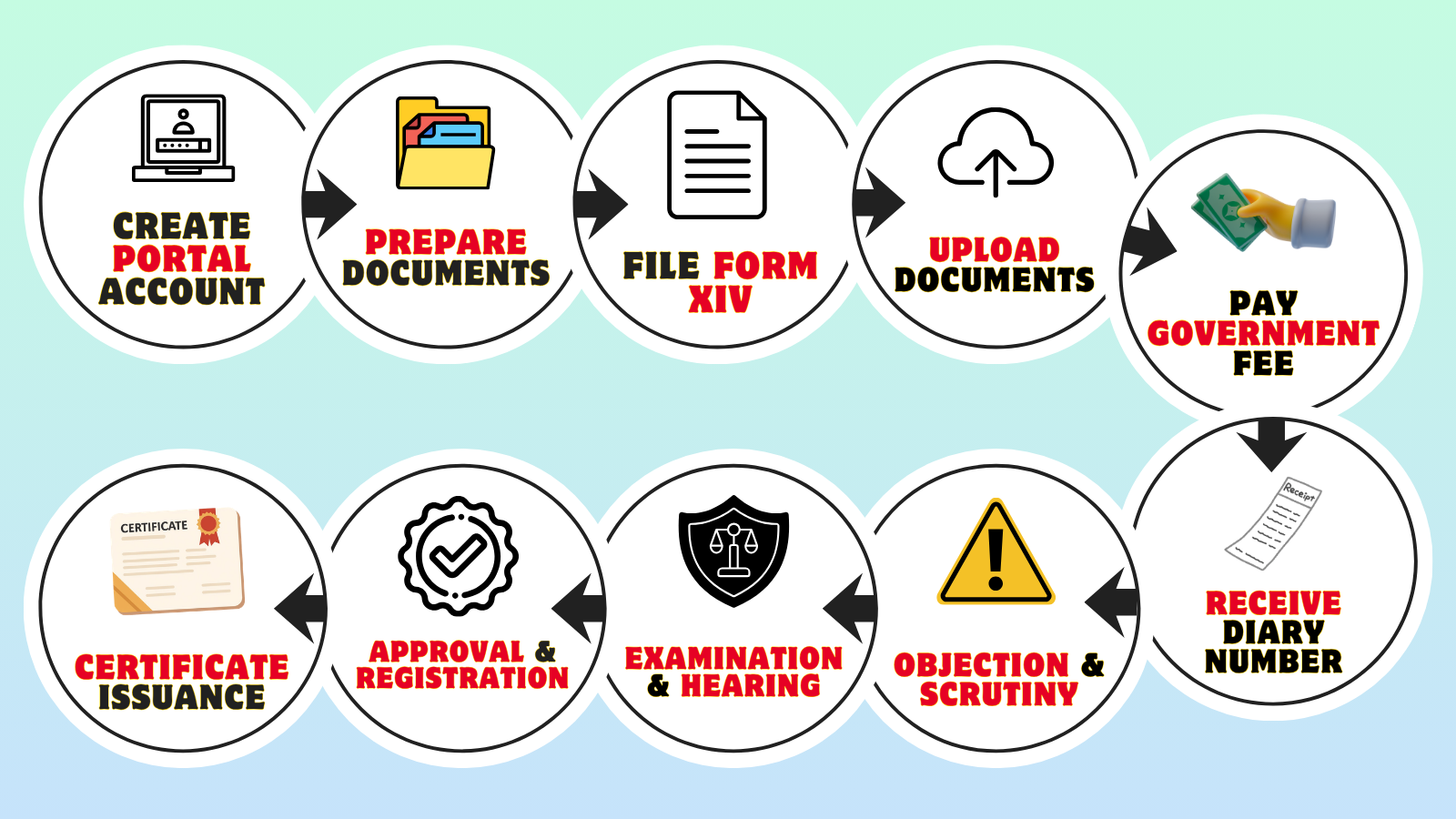
- Create an Account: Register on the official Copyright Office website.
- Prepare Documents: Keep digital copies and supporting documents ready.
- File Form XIV: Submit the copyright application online.
- Upload Documents: Upload work copies and supporting documents.
- Pay Government Fee: Complete online payment through Bharat Kosh.
- Receive Diary Number: A unique diary number is generated for tracking.
- 30-Day Waiting Period: Mandatory public objection period.
- Examination & Scrutiny: Application review by the Copyright Office.
- Approval & Registration: Successful applications are entered into the Register of Copyrights.
- Certificate Issuance: The Copyright Registration Certificate is issued digitally.
Copyright Registration Fees
The government fee for copyright registration in India varies depending on the category of work being registered.
| Type of Work | Fee (₹) | Examples |
|---|---|---|
| Literary, Dramatic, Musical, Artistic Work | ₹500 | Books, poems, scripts, paintings |
| Artistic Work for Goods/Services (Logos, Branding) | ₹2000 | Logos, packaging art, commercial designs |
| Cinematograph Film | ₹5000 | Movies, YouTube videos, short films |
| Sound Recording | ₹2000 | Songs, podcasts, audiobooks |
| Musical Work (Composition, Lyrics, Notation) | ₹500 | Sheet music, lyrics, melodies |
| Software / Computer Programs | ₹500 | Source code (first & last 10 pages) |
Each work requires a separate application and fee.
Registration is voluntary but highly recommended for legal protection.
The effective date is the date of filing, not approval.
Processing time is usually 2–3 months if no objections are raised.
Timeline & Validity for Copyright Registration
The complete timeline for copyright registration in India generally ranges from 2 to 8 months depending on objections, discrepancies, and examination stages.
Summary of Timelines
| Scenario | Estimated Total Time |
|---|---|
| Uncontested (Smooth Process) | 2 – 4 Months |
| With Minor Discrepancies | 4 – 6 Months |
| With Third-Party Objections | 8 – 12+ Months |
The validity period depends on the category of work registered under the Copyright Act, 1957.
- Literary, Dramatic, Musical, Artistic Works: Lifetime of the author + 60 years.
- Cinematograph Films and Sound Recordings: 60 years from publication.
- Broadcast Rights: 25 years from broadcast.
- Performers’ Rights: 50 years from performance.
Difference Between Trademark, Patent and Copyright
Understanding the differences between these three pillars of intellectual property (IP) is crucial for any business or creator. While they all provide protection, they target entirely different aspects of your work: creative expression, brand identity, and technical innovation.
| Feature | Copyright | Trademark | Patent |
|---|---|---|---|
| Primary Goal | Protects original creative expressions. | Protects brand identity and commercial source. | Protects inventions and technical solutions. |
| Subject Matter | Books, music, films, software code, art. | Brand names, logos, slogans, symbols. | New products, industrial processes, machines. |
| Registration | Automatic upon creation (but registration adds legal strength). | Recommended; required for stronger legal remedies. | Mandatory; no protection without a formal grant. |
| Duration (India) | Lifetime of author + 60 years. | 10 years; renewable indefinitely. | 20 years; non-renewable. |
| Symbol | © (or ℗ for sound recordings). | ™ (unregistered) or ® (registered). | No specific typographic symbol. |
Need Help with Copyright Registration?
Let our experts handle the Copyright registration process for you. Get started today!
Frequently Asked Questions (FAQs)
Is copyright registration mandatory in India?
No. Copyright protection in India is automatic once an original work is created and fixed in a tangible form. However, copyright registration provides strong legal proof of ownership and is highly recommended for legal protection and enforcement.
Who can apply for copyright registration?
The following persons or entities can apply for copyright registration in India:
- The original author or creator of the work
- The owner or employer if the work was created during employment
- A commissioning party for commissioned works such as films or photographs
- An authorized agent or representative with a valid Power of Attorney (POA)
How long does copyright protection last?
The validity of copyright protection depends on the type of creative work:
- Literary, musical, artistic, and dramatic works: Lifetime of the author + 60 years
- Cinematograph films and sound recordings: 60 years from publication
- Government and international organization works: 60 years from publication
What is the fee for copyright registration?
The government fee for copyright registration in India depends on the type of work being registered:
- ₹500 for literary, artistic, musical works, and software
- ₹2,000 for logos and sound recordings
- ₹5,000 for cinematograph films
A separate copyright application and government fee is required for each individual work.
How long does the copyright registration process take?
Usually, the copyright registration process takes around 2–3 months, provided no objection is raised during the mandatory 30-day waiting period after application filing.
What happens if someone infringes my copyright?
Copyright infringement can result in both civil and criminal remedies under the Copyright Act, 1957.
- Civil remedies include injunctions, damages, and destruction of infringing copies
- Criminal remedies may include fines, imprisonment, and seizure of equipment used for infringement
Are there any exceptions to copyright protection?
Yes. Under the fair dealing provisions of Indian copyright law, certain uses of copyrighted works are allowed without permission for purposes such as:
- Education and research
- News reporting
- Criticism and review
- Judicial proceedings
- Private and non-commercial use
Why should businesses register copyright if protection is automatic?
Although copyright protection is automatic, registration provides legal proof of ownership, which becomes extremely important during disputes or infringement claims.
- Strengthens legal protection for original work
- Enhances company valuation by securing intellectual property assets
- Builds credibility among investors, partners, and clients
- Makes enforcement and legal action easier in case of infringement
Can a company own copyright instead of an individual?
Yes. If a creative work is developed by an employee during the course of employment, the employer or company generally becomes the first owner of the copyright unless otherwise specified in the employment agreement or contract.